Back to 2026 Abstracts
Better Late Than Never: Kidney Function Trajectory Improves with Transition to a Standardized PUV Multidisciplinary Clinic
Mandy Rickard, MN, NP, Joana Dos Santos, MD, Michael Chua, MD, Adree Khondker, MD, Joao Pippi Salle, MD, Ashlene McKay, MD, Chia Wei Teoh, MD, Nithiakishna Selvathesan, MD, Armando J. Lorenzo, MD.
SickKids, Toronto, ON, Canada.
BACKGROUND: In 2019 our institution created a dedicated posterior urethral valves (PUV) clinic with a standardized multidisciplinary care pathway. Prior work demonstrated superior kidney outcomes for children managed entirely within this model. However, many patients received initial care before clinic implementation, with some later transitioning into this structured approach (“Hybrid”). We hypothesized that even delayed entry into a standardized multidisciplinary model confers measurable benefit compared to historical unstructured care.
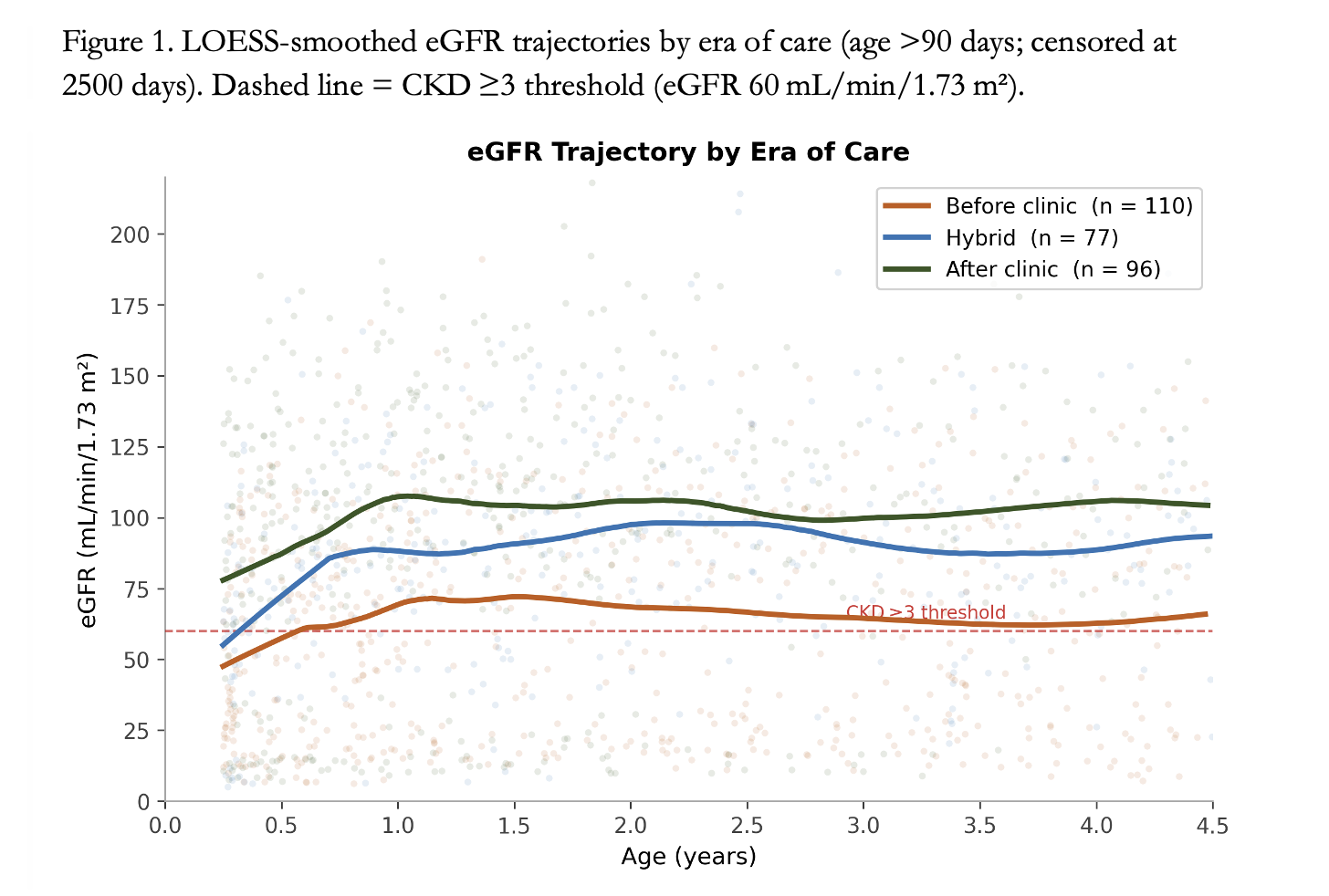
METHODS: We reviewed our institutional PUV database (2005-2026) and classified 283 patients into three groups: Before (managed exclusively prior to clinic implementation, n = 110), Hybrid (managed ≥50% within the PUV clinic, or presenting post-2019 with prior external care, n = 77), and After (managed entirely within the clinic, n = 96). Outcomes included nadir creatinine, creatinine at one year, progression to CKD stage ≥3 (eGFR < 60 mL/min/1.73 m²), and kidney replacement therapy (KRT). Baseline PURK scores were used to characterize disease severity across groups. eGFR trajectories were derived from longitudinal creatinine data (age >90 days, censored at 2500 days) and plotted using LOESS smoothing.
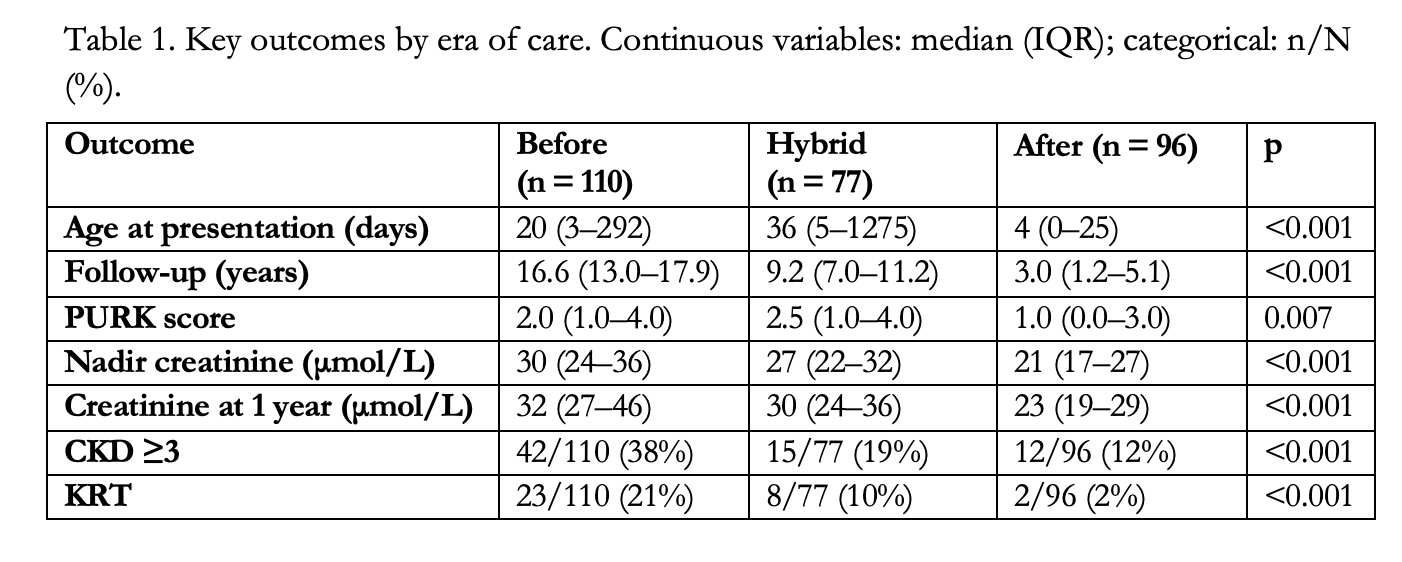
RESULTS: We included 110 Before, 77 Hybrid, and 96 After patients. Follow-up differed substantially across groups (median 16.6 (13.0-17.9), 9.2 (7.0-11.2), and 3.0 (1.2-5.1) years respectively; p<0.001), reflecting the recency of the clinic model. The After group presented youngest (median 4 days, IQR 0-25), consistent with systematic prenatal detection; the Hybrid group presented latest (median 36 days, IQR 5-1275), reflecting delayed referral from external centres (p<0.001). Hybrid patients carried the highest baseline PURK scores (median 2.5 vs. 2.0 vs. 1.0; p = 0.007), indicating greater disease severity despite later entry into structured care. Despite this, Hybrid patients achieved outcomes intermediate between Before and After groups across all measures (Table 1). Nadir creatinine fell progressively from 30 to 27 to 21 μmol/L (p<0.001) and creatinine at one year from 32 to 30 to 23 μmol/L (p<0.001). Progression to CKD ≥3 occurred in 38%, 19%, and 12% respectively (p<0.001), and KRT rates followed the same downward gradient at 21%, 10%, and 2% (p<0.001). eGFR trajectories showed sustained divergence from infancy across all three eras (Figure 1).
CONCLUSIONS:Implementation of a standardized, multidisciplinary PUV clinic is associated with improved kidney outcomes in a gradient across eras of care. Critically, patients transitioning into this model after an initial period of unstructured care still achieve substantially better outcomes than those never exposed to the pathway. These findings support the value of enrolling all PUV patients into a structured clinic, regardless of the stage at which they present.
Back to 2026 Abstracts


