Back to 2026 Abstracts
Exploring Precision Risk in Pediatric Vesicoureteral Reflux: Innate Immune Gene Variations and Reflux Outcomes in the RIVUR Cohort
Jin Kyu (Justin) Kim, MD, MS, Rosalia Misseri, MD, Joshua Roth, MD, PhD, Andrew Schwaderer, MD, Shaobo Zhang, MD, David Hains, MD, MBA.
Riley Hospital for Children, Indianapolis, IN, USA.
BACKGROUND:Children with vesicoureteral reflux (VUR) are at increased risk for morbidity from recurrent urinary tract infections (UTIs), yet the factors influencing spontaneous VUR resolution remain poorly defined. This study evaluates whether genetic variations in key urinary innate immune effectors (DEFA1A3, DMBT1, and RNASE7) influences VUR resolution and interacts with prophylaxis to alter clinical response.
METHODS:We conducted a secondary analysis of 303 RIVUR participants with available DEFA1A3 and DMBT1 copy number variation (CNV) data and RNASE7 rs1263872 genotype. Primary outcomes were (1) VUR improvement (decrease in grade) and (2) VUR resolution at study exit. Multivariable logistic regression models included genotype, treatment, and their interactions, adjusting for age, sex, baseline grade (high vs low), laterality, bowel/bladder dysfunction, and any UTI. Internal validation used 2,000-sample bootstrap with bias-corrected and accelerated confidence intervals and influence diagnostics.
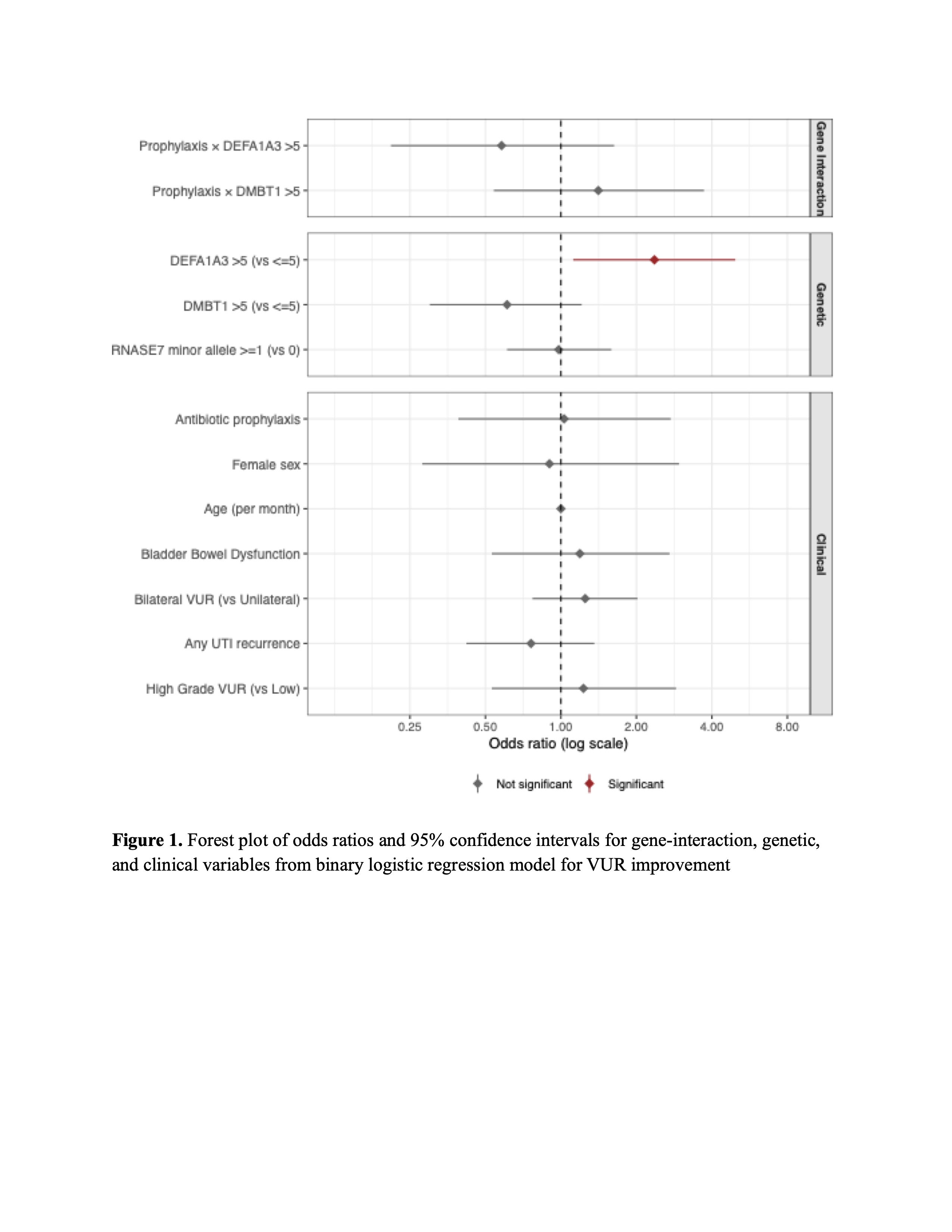
RESULTS:Clinical covariates did not significantly predict VUR improvement. Children with DEFA1A3CNV >5 had higher odds of improvement (OR 2.36, 95% CI 1.12-4.96, p=0.023;
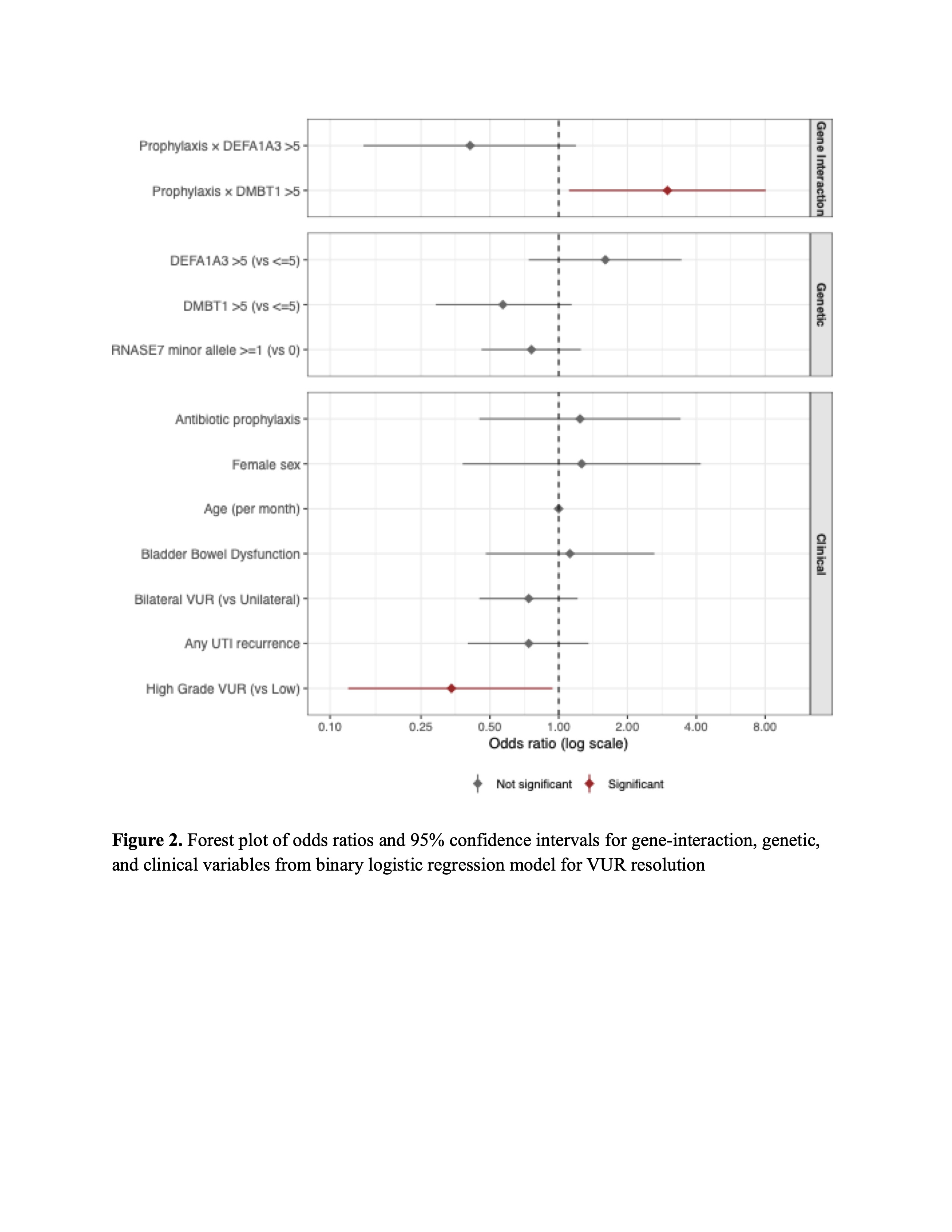
Figure 1), an effect that remained significant in bootstrap analyses. High-grade VUR was associated with lower odds of resolution (OR 0.34, 95% CI 0.12-0.94, p=0.038). A significant interaction was observed between prophylaxis and high DMBT1 copy number for VUR resolution (interaction OR 2.99, 95% CI 1.11-8.04, p=0.031;
Figure 2); no interaction was seen for improvement. RNASE7 rs1263872 was not associated with either outcome.
CONCLUSIONS:Innate immune gene variation may contribute to heterogeneity in VUR outcomes. High DEFA1A3 copy number favors reflux improvement, whereas DMBT1 appears to synergize with prophylaxis to promote resolution. These data support genetically informed, precision approaches to VUR counseling and management.
Back to 2026 Abstracts


