Back to 2026 Abstracts
Efficacy and Predictors of Remission of Intravesical Tobramycin to Address Urinary Tract Infections in Children with Neurogenic Bladder and Lower Urinary Tract Obstruction
Nikan Zerafatjou, MD, LMC Clinical Fellow in Pediatric Urology, Mandy Rickard, MN, NP-Peds, Abby Varghese, RN(EC), NP-PHC, Ana Bernal, MD, Michael Chua, MD, MASc, DSc, DRCPSC, FRCSC, Armando Lorenzo, MD, MSc, FRCSC, FAAP, Joana Dos Santos, MD, MSc, FRCPC, FAAP.
The Hospital for Sick Children (SickKids), University of Toronto, Toronto, ON, Canada.
BACKGROUND- Intravesical aminoglycosides are often used to manage recurrent urinary tract infections (UTIs) in children with complex lower urinary tract conditions, yet published data are limited, particularly regarding predictors of sustained remission after treatment discontinuation. Moreover, evidence on therapeutic benefit often fails to distinguish symptomatic UTI from asymptomatic bacteriuria, which is prevalent in these children. Herein, we report a large cohort of children treated with intravesical tobramycin, aiming to identify predictors of durable UTI-free status after stopping treatment, characterize differential response by vesicoureteral reflux (VUR) status, and describe effects on the antimicrobial spectrum.
METHODS- Retrospective single-centre cohort of 96 children receiving intravesical tobramycin for recurrent symptomatic UTIs, strictly defined as a single-organism-positive urine culture (≥50,000 CFU/mL from a catheterized specimen) accompanied by clinical symptoms (fever, new-onset incontinence, increased spasticity, malodorous/cloudy urine, or suprapubic pain) that prompted antibiotic treatment. Asymptomatic bacteriuria was excluded. Underlying diagnoses included neurogenic bladder (NGB, n = 66), lower urinary tract obstruction (LUTO, n = 22), voiding dysfunction (n = 4), and other pelvic floor disorders (n = 4). Standard instillation volume was 60 mL (74%); smaller volumes (15-30 mL) were used in younger children. Median dwell time was 2 hours (89% ≥2 hours). The primary outcome was UTI-free status in the first year after stopping (stopping criterion: 1 year infection-free on treatment). Pre- versus on-treatment UTI rates were compared using the Wilcoxon signed-rank test (n = 81 paired). Predictors of durability were assessed using the Mann-Whitney U and Fisher exact tests. Culture data were reviewed for shifts in pathogen patterns.
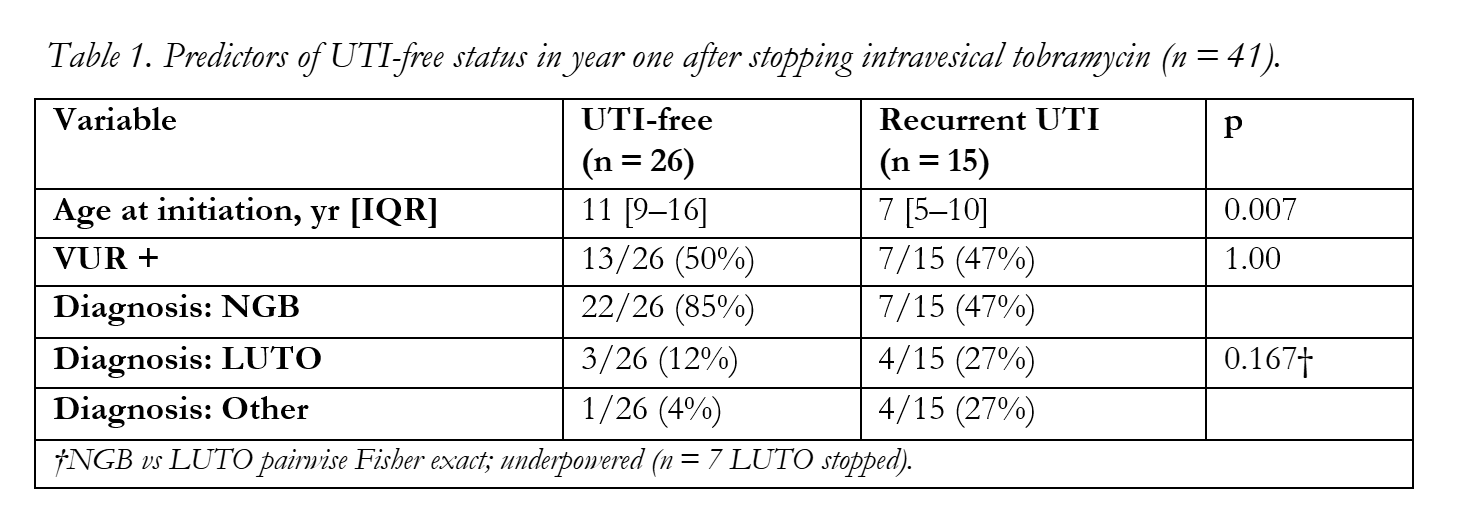
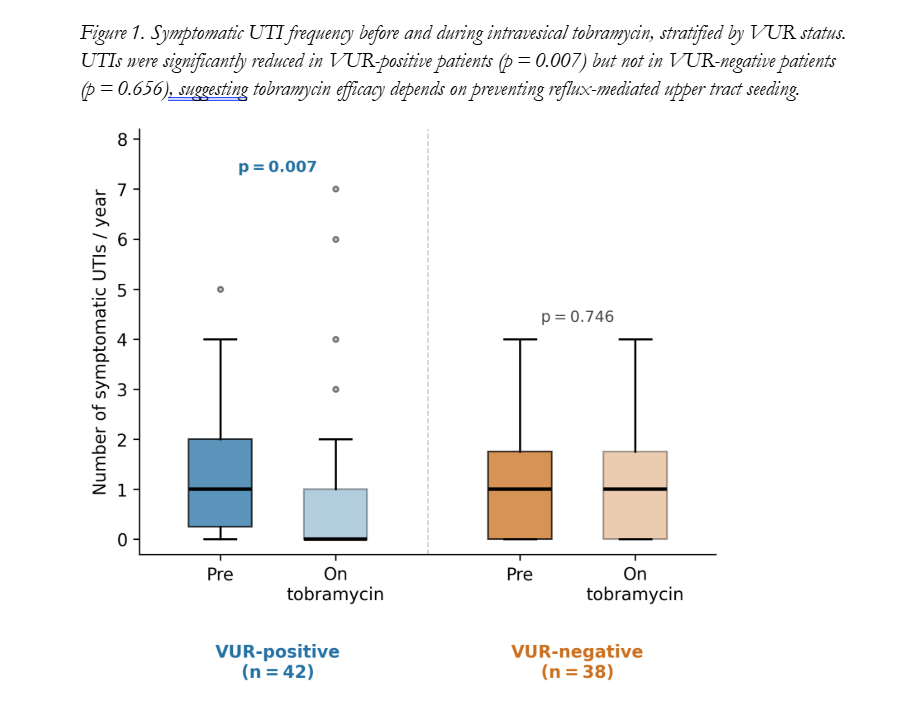
RESULTS- Overall, intravesical tobramycin significantly reduced the frequency of symptomatic UTIs (p = 0.019). Stratification by VUR revealed a differential treatment response: UTIs were significantly reduced in VUR-positive patients (median 1 to 0, p = 0.007) but not in VUR-negative patients (p = 0.656) (Figure 1). Of 41 patients who completed treatment with available follow-up, 26 (63%) remained UTI-free in year one. Older age at initiation predicted durable remission (median 11 vs 7 years, p = 0.007). NGB patients trended toward higher remission rates than children with LUTO (76% vs 43%, p = 0.167), though this comparison was underpowered (n = 7 LUTO stopped; Table 1). VUR status did not predict durability after stopping tobramycin (VUR+ 65% vs VUR− 61%, p = 1.00). Pseudomonas aeruginosa decreased from 20.8% of pre-treatment to 10.5% of breakthrough cultures, consistent with tobramycin’s antimicrobial spectrum.
CONCLUSIONS- In this cohort of children receiving intravesical tobramycin, treatment significantly reduced symptomatic UTIs, with particular efficacy in patients with reflux. Older age at initiation was associated with durable remission after discontinuing therapy. Pseudomonas prevalence decreased by 50% in breakthrough cultures. These findings support risk-stratified approaches to initiating and discontinuing intravesical tobramycin.
Back to 2026 Abstracts


