Back to 2026 Abstracts
Relationship Between Subjective Symptom Reporting, Symptom Severity, and Psychosocial Burden in Pediatric Lower Urinary Tract Dysfunction
Luke Martin, MD, Dipen Mehta, BS, Arthur Yu, BS, Denton Lord, BS, Brittany Ange, BS, MS, EDD, Selcuk Yucel, MD, Bradley Morganstern, MD.
Medical College of Georgia, Augusta, GA, USA.
BACKGROUND: Lower urinary tract dysfunction (LUTD) negatively impacts the quality of life (QoL) of many pediatric patients. Validated questionnaires are commonly used to quantify patients’ QoL and symptom severity, but these surveys have not been well compared with lower urinary tract symptoms (LUTS) reported during routine visits. Also, the relationship between symptom severity and psychosocial burden remains incompletely understood. A better understanding of the differences between clinically reported LUTS, structured symptoms severity measures, and psychosocial QoL burden could guide patient-centered management strategies.
METHODS: We performed a retrospective chart review of patients aged 5 - 17 years old who presented with LUTD to a pediatric urology clinic for their initial visit from 2018 - 2022 and completed the Pediatric Incontinence Questionnaire (PINQ), a psychosocial QoL instrument, and the Vancouver Nonneurogenic Lower Urinary Tract Dysfunction (VNLUTD) scale, a symptom severity instrument. Subjective symptoms were recorded and compared with each questionnaire’s QoL or symptom severity domain. Survey associations were assessed using Spearman correlations. Demographic and symptom predictors of PINQ and VNLUTD scores were evaluated using simple and multivariable linear regression models. Score differences by symptom count and symptom presence were assessed using Kruskal-Wallis/DSCF and Wilcoxon tests, respectively.
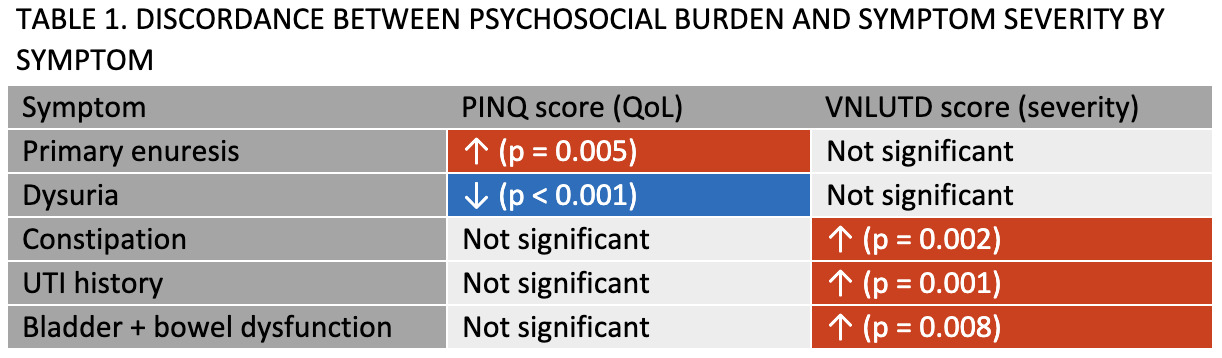
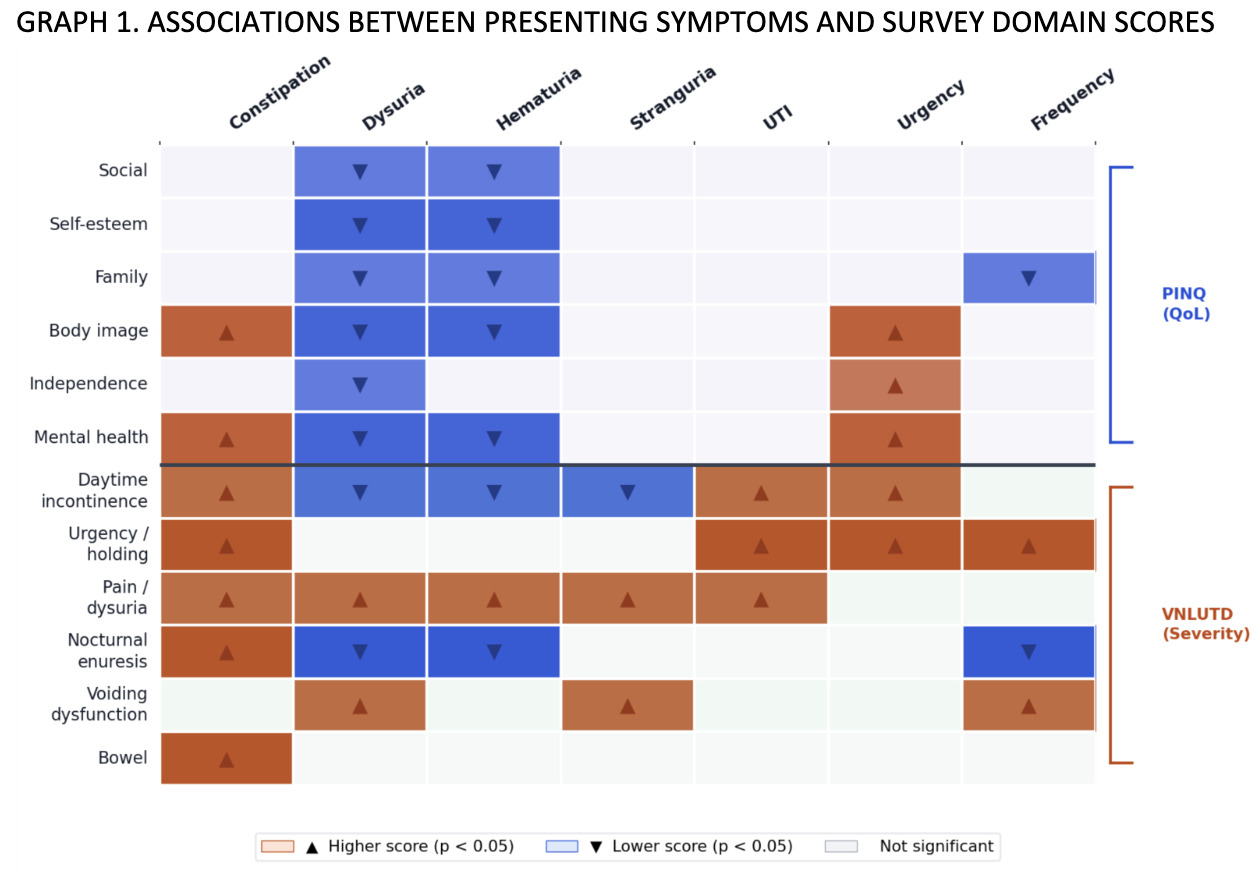
RESULTS: The study included 320 patients with a mean age of 9.5 years. Higher PINQ scores reflected worse QoL, and higher VNLUTD scores reflected greater symptom severity. PINQ and VNLUTD scores had a moderate positive correlation (r=0.382, p<0.0001). Subjective LUTS reported during patients’ first visit showed expected associations with the corresponding VNLUTD domains; however, psychosocial burden, as measured by PINQ, varied by symptom type. Primary enuresis was associated with higher PINQ (21.0 vs 16.7, p=0.005) without increased VNLUTD. Dysuria was associated with lower PINQ scores (12.2 vs 19.3, p<0.0001) without VNLUTD difference. Constipation (20.9 vs 17.9, p=0.002), combined bladder and bowel dysfunction (21.7 vs 18.0, p=0.0078), and UTI (22.8 vs 19.1, p=0.001) were associated with higher VNLUTD but not PINQ. The presence of one or more symptoms was associated with higher VNLUTD scores, but not with PINQ scores.
CONCLUSIONS: Certain symptoms disproportionately affect pediatric quality of life compared to others. Subjective symptom reporting demonstrated clinically coherent associations with symptom severity domains, but did not associate as closely with QoL domains. This opens the possibility of creating more accurate tools to quantify QoL in pediatric LUTD in the future. Also, symptom analyses revealed discordance between psychosocial burden and symptom severity for certain symptoms. Symptom severity alone may therefore not fully capture the patient's disease burden. These results support the use of both QoL and symptom-severity measures in clinical evaluation and show the need for both symptom-targeted treatment and psychosocial considerations in the management of pediatric LUTD.
Back to 2026 Abstracts


