Back to 2026 Display Posters
Standardization of clinical workflow, patient education, and documentation for uroflow utilization: a quality improvement initiative
Julie W. Cheng, MD, MAE, FAAP, Paul A. Merguerian, MD, MS, Karyn Yonekawa, MD, Ateka Al-Hassan, MBBS, Brett Niessen, MPH, Nicole McMannis, CPNP, Kathleen Kieran, MD, MSc, MME.
Seattle Children's Hospital, Seattle, WA, USA.
BACKGROUND: Incomplete uroflowmetry (“uroflow”) presents a missed opportunity to obtain information that could change management of bladder bowel dysfunction. While uroflow accuracy requires an optimal bladder volume for detrusor contractility and effective emptying, patients at our institution were historically counseled to arrive with a “comfortably full” bladder to achieve an adequate age-adjusted bladder volume during uroflow. However, there was no consistent preparation related to fluid consumption or prior bladder emptying. Patients would arrive with varying bladder volumes and degrees of readiness for uroflow, with downstream effects on clinic flow and uroflow availability. The purpose of this quality improvement (QI) initiative was to improve uroflow utilization with adequate bladder volumes. We aimed for a relative increase of 20% in adequate uroflows in all children undergoing voiding evaluation within a 1-year period at our pediatric urology clinic.
METHODS: This QI initiative included pediatric urology patients seen in clinic January 2025 through January 2026 with uroflow ordered and documented in the medical record. Principles of QI science were applied through an iterative process of current state measurements and PDSA cycles. An intervention study design was used to assess uroflow completion with the standardization of several aspects of care: provider documentation and billing for baseline measures, patient education materials during PDSA#1, and identifying patients for uroflow during PDSA#2. Patient education materials were developed with consideration of timing and volume of fluid consumption, timing of voiding, and use of plain language, visual aids, a step-wise flow chart, and volume equivalents. The primary outcome measure of this study was the proportion of uroflows completed with adequate bladder volumes (adequate uroflows). Subgroup analysis was stratified by adequate uroflow completion.
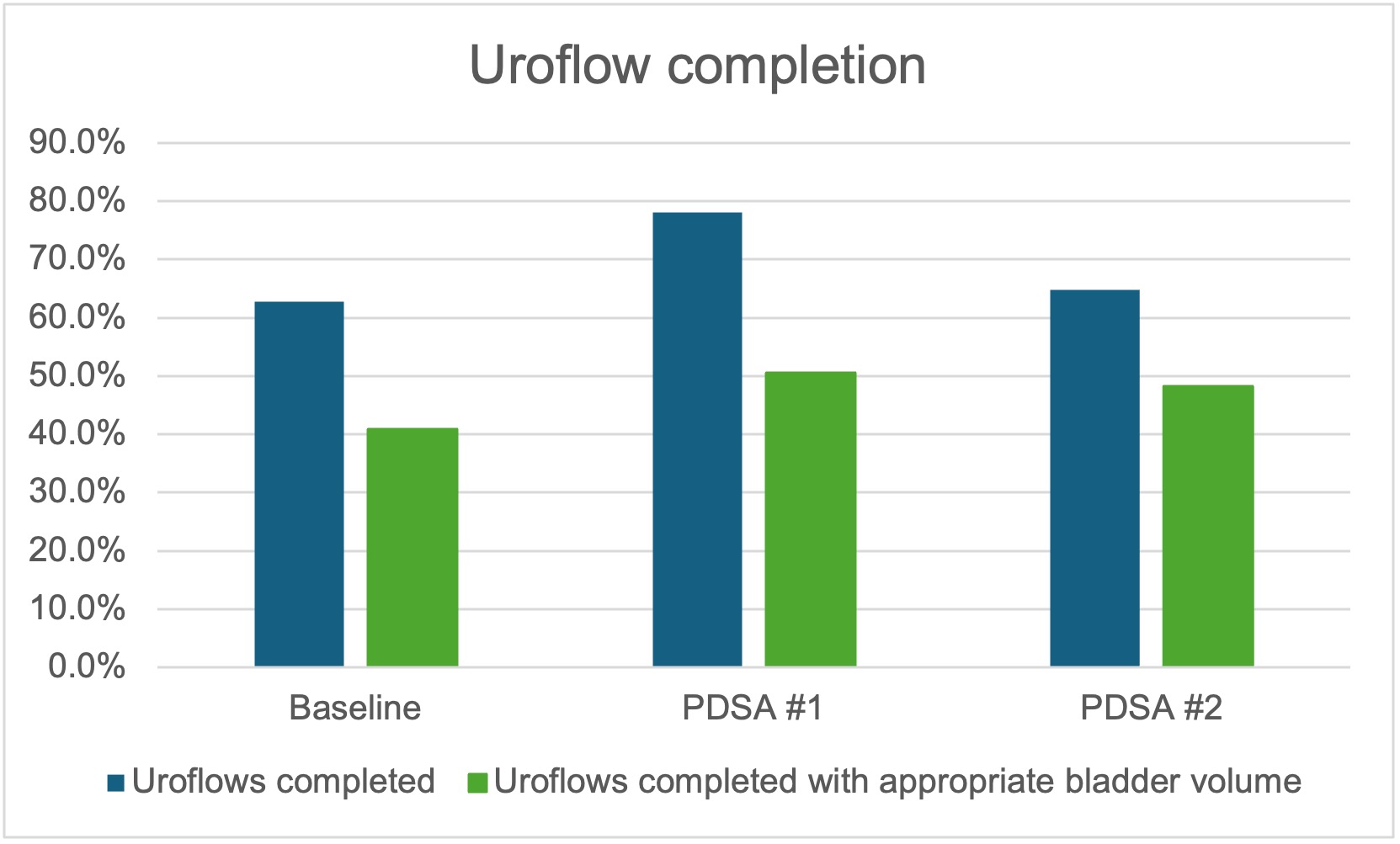
RESULTS: A total of 679 uroflow encounters were included: 137 (20.2%) at baseline, 366 (53.9%) during PDSA #1, and 176 (25.9%) during PDSA #2. Median patient age was 9 (IQR 7-12) years and 51.1% of encounters involved female patients. Patient education intervention was administered prior to 198 encounters (29.2%) with 0% at baseline, 35.2% during PDSA#1, and 39.2% during PDSA#2. There were 486 uroflows completed (71.6%) with 326 uroflows with adequate bladder volumes (48.0%). The proportions of uroflow completion in Figure 1 demonstrate an increase in adequate uroflows from 40.9% at baseline to 50.5% during PDSA #1 and 48.3% during PDSA#2. Adequate uroflows were associated with older age (p=0.007), patient education intervention (p=0.044), and greater distance between home and clinic site (p=0.009). Adequate uroflows were not associated with race, language of care, interpreter use, insurance type, or the route through which instructions were administered. On multivariate analysis, there was a significant increase in the odds of adequate uroflow completion with patient education intervention (OR 1.45, 95% CI 1.03-2.03) and older patient age (OR 1.06, 95% CI 1.02-1.11).
CONCLUSIONS: Uroflow clinical workflow, patient education, and documentation were standardized in this QI initiative. Uroflow completion with adequate bladder volumes improved with patient education intervention.
Back to 2026 Display Posters


