Back to 2026 Display Posters
Probability of Bladder Augmentation and Incidence of Clean Intermittent Catheterization with Isolated Epispadias: A 20-Year, Multi-Institutional, Retrospective Cohort Study
Brian VanderBrink, MD1, Konrad Szymanski, MD, MPH2, Diana Bowen, MD3, Candance Granberg, MD4, Molly Fuchs, MD5, Andrew Strine, MD/MPH1, Nikhil Batra, MD2, on behalf of Pediatric Urology Midwest Alliance PUMA, -6.
1Cincinnati Childrens Hospital Medical Center, Cincinnati, OH, USA, 2Riley Children's Hospital, Indianapolis, IN, USA, 3Lurie Children's Hospital, Chicago, IL, USA, 4Mayo Clinic, Rochester, MN, USA, 5Nationwide Children's Hospital, Columbus, OH, USA, 6
BACKGROUND: Isolated epispadias is a rare condition with incidence of 1:500,000 births. The condition has impact on urinary function and outcomes in large series of affected patients is sparse. We assessed the probability of clean intermittent catheterization in isolated epispadias in a multi-institutional cohort.
METHODS: We included children born from 2000 to 2025 with isolated epispadias and treated across 5 centers (We excluded patients with bladder or cloacal exstrophy). Epispadias severity was assessed from retrospective chart review. Clinical outcomes measured were bladder augmentation/diversion rates after epispadias repair and proportion of patients performing clean intermittent catheterization (CIC) at last follow-up. Survival analysis was used. We also compared epispadias outcomes to our collaborative experience with classic bladder exstrophy (J Urol 2019 202:1256)
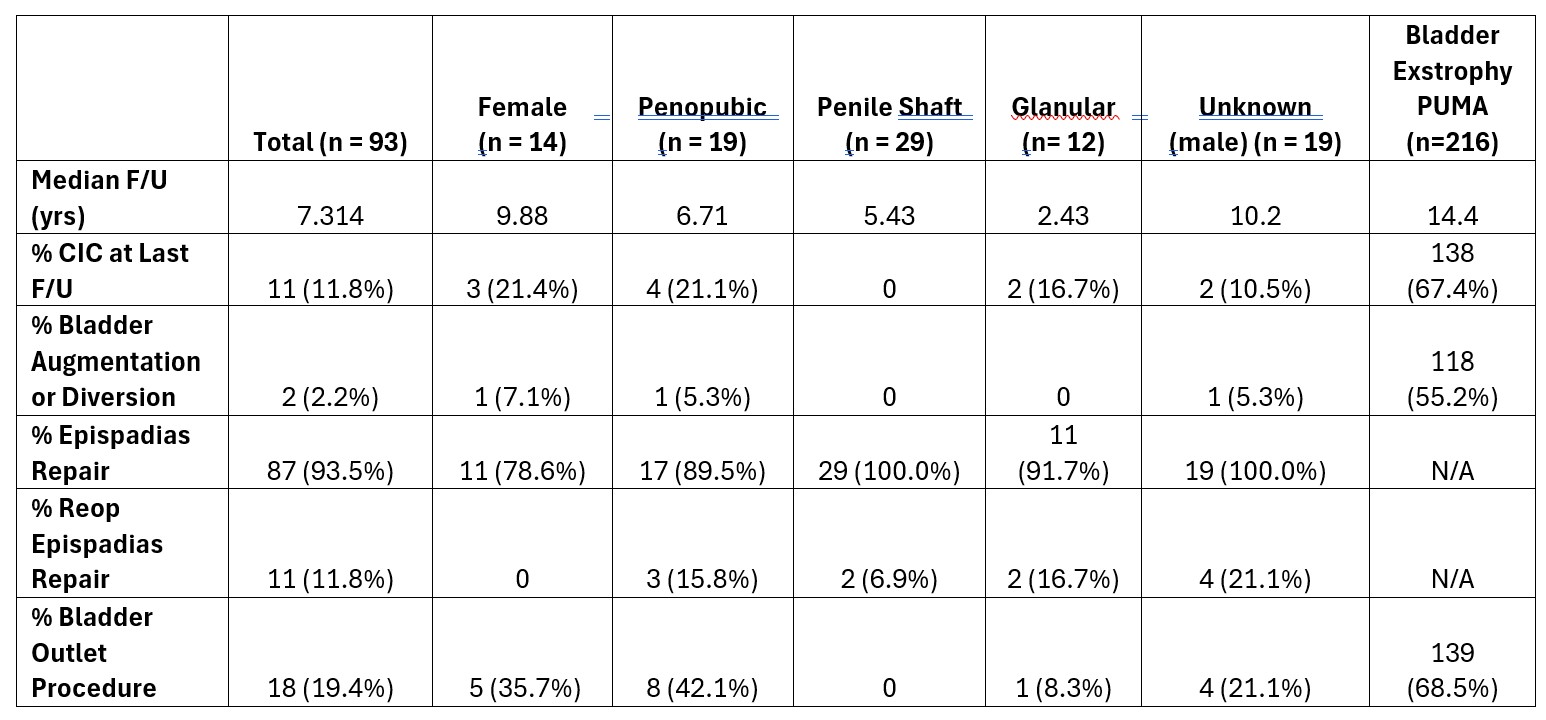
RESULTS: Of 93 patients, 84.9% were male with a median follow-up 7.8 years. (Table1) The male meatus location was described as penopubic in 19, on penile shaft in 29, glanular/coronal sulcus in 12 and unknown in 19 patients. Surgical repair occurred in 87 patients (76 males) at median 10 months old with varying techniques. Male epispadias surgical techniques were Cantwell Ransley repair(n=42), urethroplasty alone without corporal rotation/plication (n=20), total penile disassembly (n=8), and unknown (n=6). Female epispadias surgical techniques were urethroplasty alone (n=8),urogenital mobilization (n=2) and unknown (n=1). Bladder outlet procedures were performed in 18 patients with 6 having the bladder outlet procedure at the time of epispadias repair. 8 patients, all male, underwent reoperative epispadias repair. 76 patients were older than 5 years at last follow up. At median follow-up of 7.3 years from surgical repair, 12.5% (n=11) performed CIC. Bladder augmentation was performed in 2 patients and urinary diversion in 1. On survival analysis, the probability of augmentation/diversion was 0% and 2.5% by 5 and 10 years, respectively.
CONCLUSIONS: On follow-up probability of bladder augmentation/diversion was low in this series of isolated epispadias with intermediate length follow-up in childhood. Although shorter follow up time, there was lower rates of CIC, augmentation and bladder outlet procedures in this epispadias population compared to classic bladder exstrophy.
Back to 2026 Display Posters


