Back to 2026 Display Posters
Hydronephrosis Severity Index vs. Percent Improvement in Anteroposterior Diameter: Comparative Performance for Predicting Pyeloplasty Outcome
Usman Kahloon, MPH, Samer Maher, MSc, Adree Khondker, MD, Lauren Erdman, PhD, Innocent Nzeyimana, MD, Joana Dos Santos, MD, Rodrigo Romao, MD, Michael Chua, MD, Armando Lorenzo, MD, Mandy Rickard, MN.
The Hospital for Sick Children, Toronto, ON, Canada.
BACKGROUND: The Hydronephrosis Severity Index (HSI) was developed to quantify hydronephrosis severity using ultrasound parameters. Although its preoperative value is established, its utility as a postoperative outcome measure after pyeloplasty has not been validated against existing clinical tools. We compared HSI percent improvement at first follow-up with the PI-APD (percent improvement in anteroposterior diameter), a previously validated predictor of pyeloplasty failure, to predict the need for reoperation.
METHODS: Retrospective review of all pyeloplasty patients with available preoperative HSI and first postoperative follow-up data (n = 220). HSI percent improvement was calculated as (HSI pre − HSI 1st post) / HSI pre × 100. PI-APD was calculated as the percent reduction in anteroposterior pelvic diameter at first follow-up. The primary outcome was reoperation (n = 21, 10%). Discriminative performance was compared using the area under the ROC curve (AUC). Correlation between measures was assessed using Spearman’s rho.
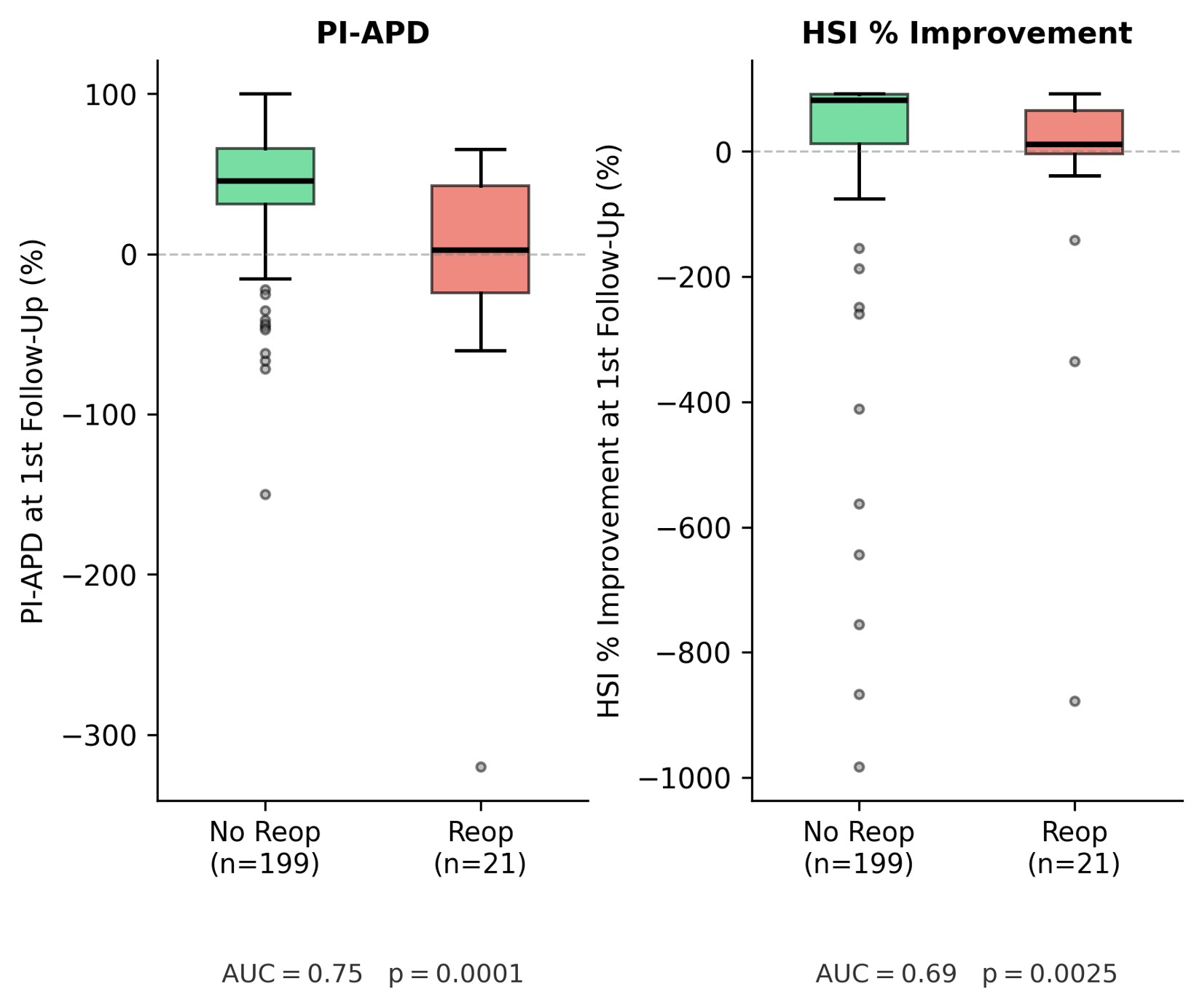
RESULTS: Preoperative HSI alone was a poor predictor of reoperation (AUC = 0.58). At first follow-up, PI-APD outperformed HSI percent improvement in predicting reoperation (AUC 0.75 vs 0.69; Figures 1 and 2). Patients who ultimately required reoperation showed markedly less improvement on both measures: PI-APD median 3% vs 46% (p = 0.0001), and HSI improvement median 11% vs 82% (p = 0.0025). The two measures showed only modest correlation at first follow-up (Spearman r = 0.22, p = 0.0011), suggesting they capture partially distinct information. At final follow-up, HSI was uninformative (AUC = 0.51), driven by a floor effect: 148/199 (74%) of patients reached the computational HSI minimum by last imaging, eliminating discriminatory capacity.
CONCLUSIONS: HSI percent improvement at first follow-up provides modest discrimination for pyeloplasty failure but is outperformed by PI-APD. PI-APD remains the stronger early predictor. HSI offers limited added value beyond APD-based assessment for outcome surveillance in the postoperative setting.
Figure 1. ROC curves for predicting reoperation (n = 220). Pre-op HSI (AUC 0.58) provides no meaningful discrimination. PI-APD at first follow-up (AUC 0.75) outperforms HSI percent improvement (AUC 0.69).
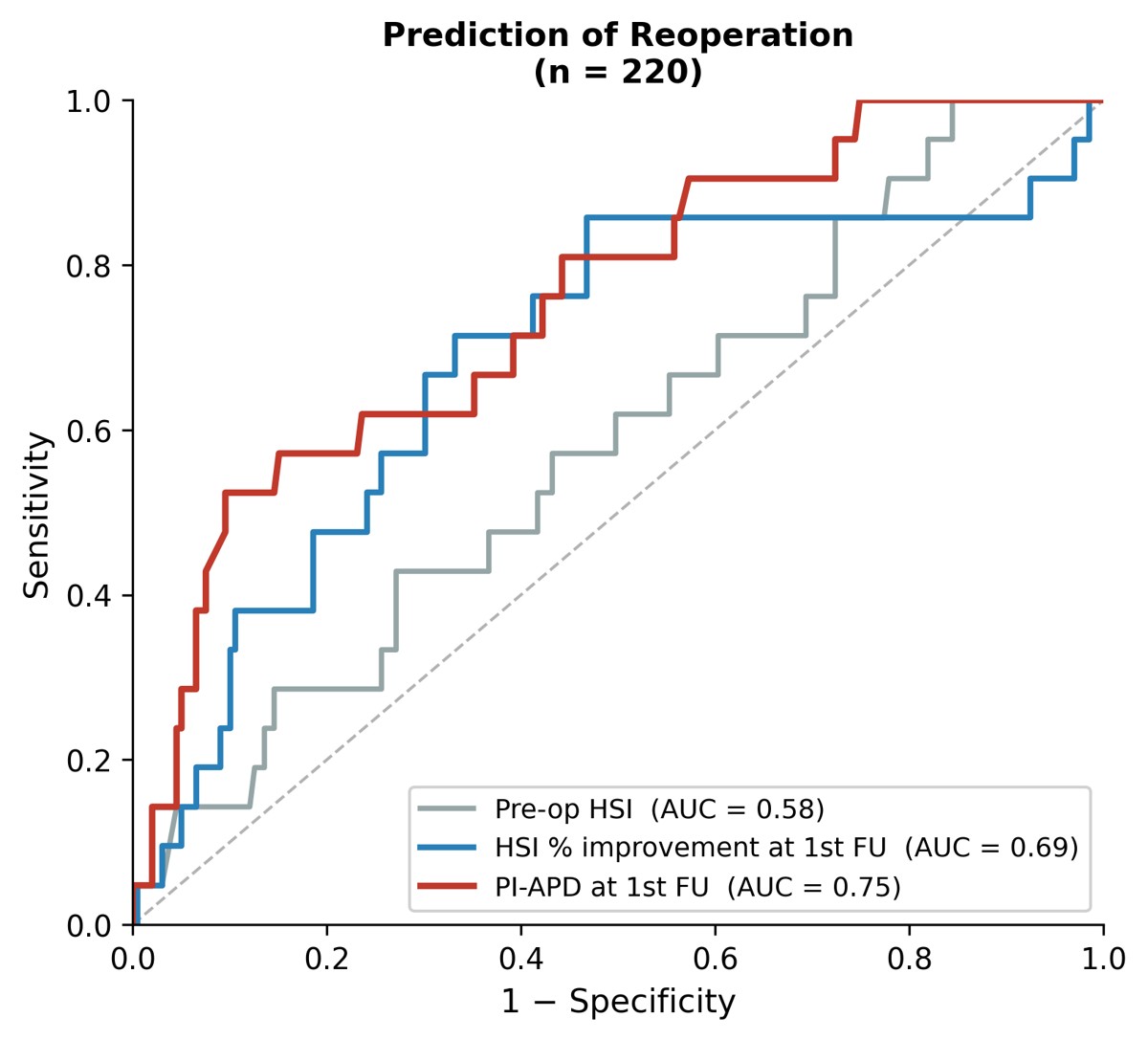 Figure 2.
 PI-APD (left) and HSI percent improvement (right) at first follow-up stratified by reoperation status. Both measures are significantly lower in patients requiring reoperation (p = 0.0001 and p = 0.0025, respectively). PI-APD shows greater separation and a higher AUC (0.75 vs 0.68).
Back to 2026 Display Posters


