Back to 2026 Display Posters
Bladder Distention Impacts Distal Ureteral Dilation, but not UTD score or Renal Pelvic Diameter in Newborns with Urinary Tract Dilation
Kenneth A. Softness, MD, George Sideris, MD, Michael P. Kurtz, MD MPH, Neha Kwatra, MD, Jeanne S. Chow, MD, Caleb P. Nelson, MD MPH.
Boston Children's Hospital, Boston, MA, USA.
BACKGROUND: It is commonplace in discussions of urinary tract dilation (UTD) to assume that the degree of bladder distention may impact the degree of hydronephrosis or distal ureteral dilation. However, limited data exist regarding the actual correlation of bladder distention with these parameters, particularly in newborns undergoing renal bladder ultrasound (RBUS). Using an institutional dataset of 495 newborns undergoing RBUS for antenatally identified UTD, we aimed to determine the association of bladder distention with renal pelvic diameter, distal ureteral diameter, and UTD classification.
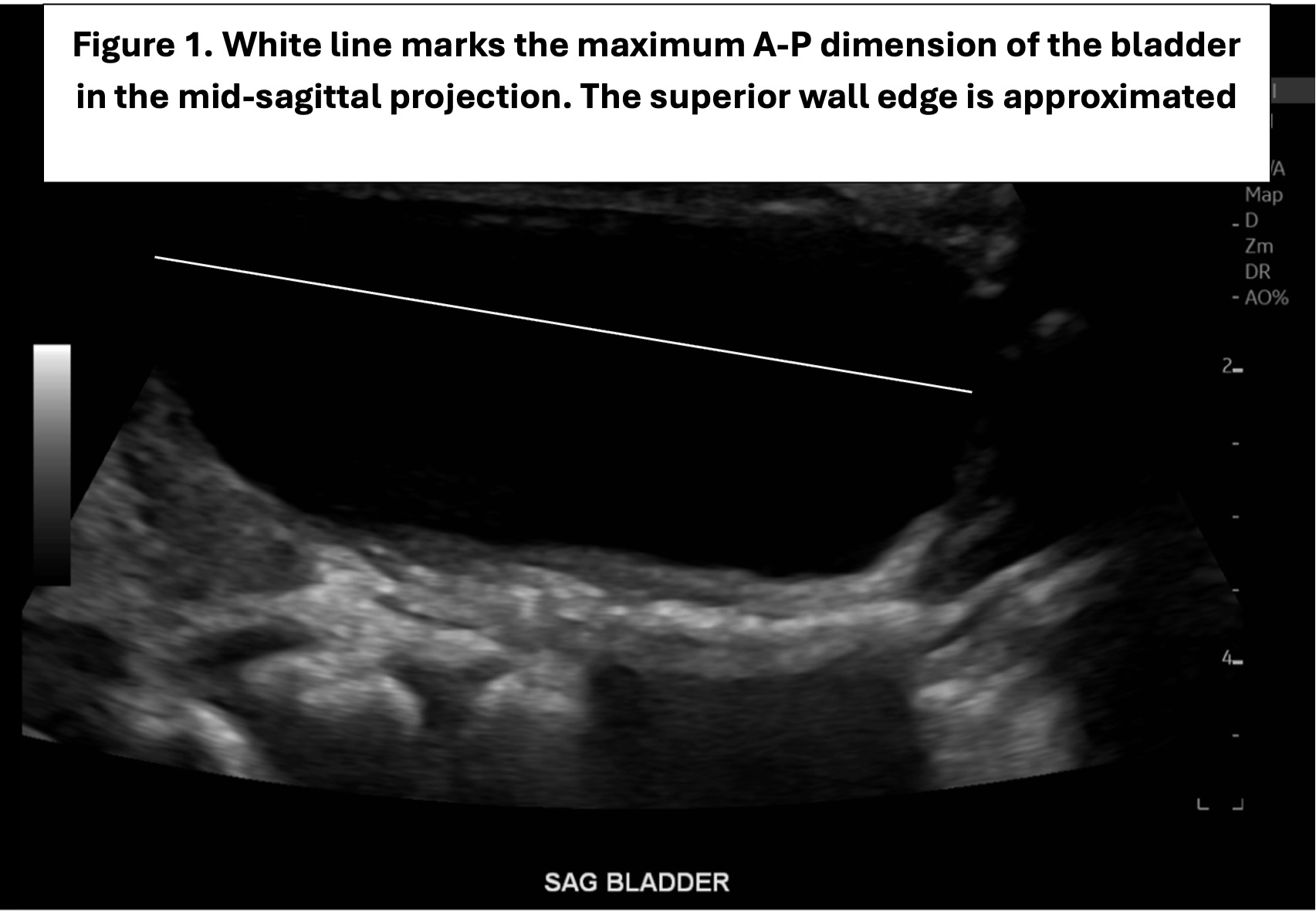
METHODS: We performed a retrospective review of 495 neonatal RBUS, utilizing two reviewers to collect all parameters from the UTD classification system to assign UTD score to each patient. Additionally, both reviewers measured the greatest craniocaudal dimension of each patient’s bladder on the sagittal bladder images taken prior to measurement of the right and left renal pelves. (Figure 1) We used linear regression to evaluate the association of bladder distention with the maximum anterior-posterior renal pelvic diameter (APRPD) on the right and left kidneys. Differences in bladder dimensions among UTD grade levels were analyzed with ordinal regression. The impact of bladder distention on distal ureteral dilation was assessed with both logistic and ordinal regression.
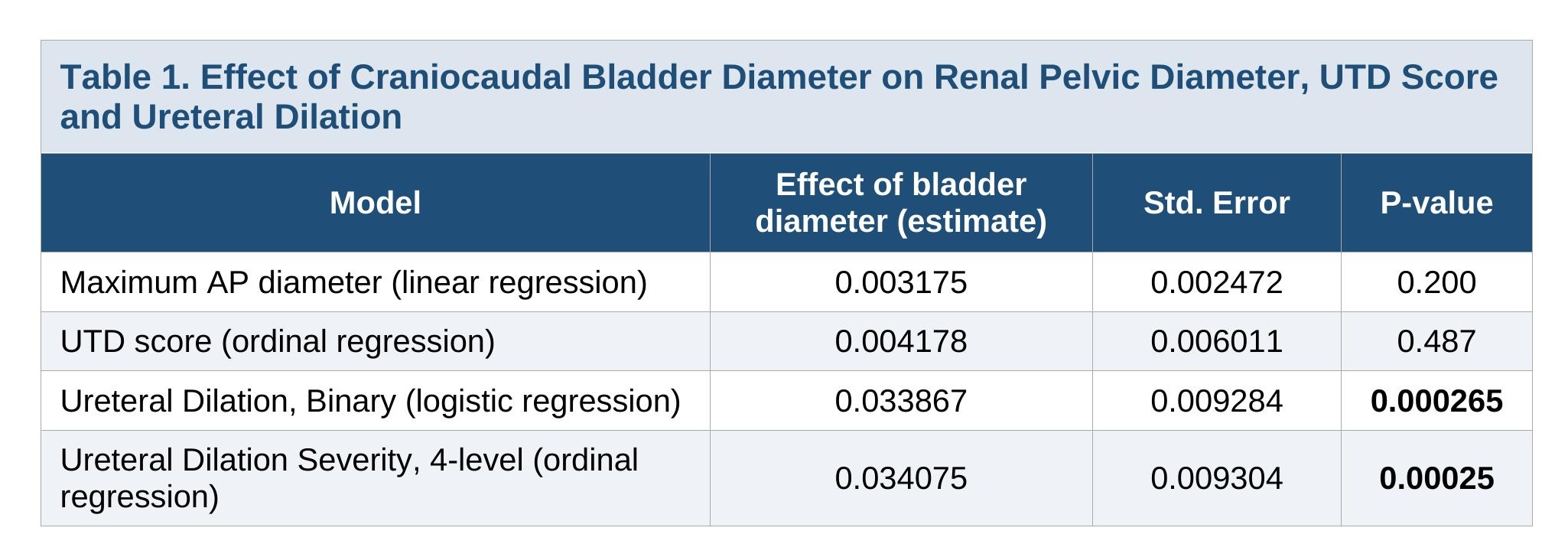
RESULTS: Among 495 patients undergoing initial postnatal ultrasound, there was no significant association between bladder fullness and APRPD. On linear analysis, the change in APRPD with craniocaudal bladder dimension was negligible: for each millimeter increase in bladder distention, there was a corresponding .003 mm increase in maximum renal pelvic diameter (p = 0.2). Bladder distention also did
not correlate with UTD score: for every stepwise increase in UTD grade, there was a corresponding 0.004 mm increase in bladder diameter (p = 0.5). However, there was a significant association between bladder diameter and ureteral dilation on both logistic regression (p < 0.01), where every millimeter increase in bladder diameter increased the odds of having ureteral dilation by 3.4%, and with ordinal regression, where every millimeter increase in bladder distention was associated with a 3.5% increase in the odds of having a more severe grade of ureteral dilation (none/mild/moderate/distal).
CONCLUSIONS: In a large cohort of newborns undergoing screening for urinary tract dilation, degree of bladder distention on ultrasound images taken just before the measurement of the renal pelvis demonstrated no significant linear relationship with APRPD. Bladder distention did not impact UTD grade. However, there was a significant positive association between bladder distention and categorical and binary classification of distal ureteral dilation. This suggests that while overall risk score or APRPD is unlikely to change based on bladder filling, ureteral dilation can be impacted by bladder filling, and this may help guide clinical decision making, especially regarding antibiotic prophylaxis, in newborns with urinary tract dilation.
Back to 2026 Display Posters


