Back to 2026 Display Posters
Genitourinary Polyps in the Pediatric Population: In the Face of a Challenging Condition Based on a Global Multicenter Experience Over 18 Years
Eman N. Chaudhri, MD1, Johana M. Paez-Cortes, MD1, Claudio Nome, MD2, Sonia Perez-Bertolez, MD3, Jose Luis Fadil, MD4, Jenny Arboleda, MD5, Chelsy Lasso Betancor, MD6, Paz Bustamante, MD7, Alejandro Acquisgrana, MD8, Marcos Perez-Brayfield, MD9, Sasha J. Vereecken, BSN10, Juan Manuel Moldes, MD11, Pedro-Jose Lopez, MD11, Francisco Reed, MD12.
1University Hospitals Cleveland Medical Center, Cleveland, OH, USA, 2Hospital de Salud Intercultural Nueva Imperial, Temuco, Chile, 3Sant Joan de Deu Barcelona Children’s Hospital, Barcelona, Spain, 4Sanatorio de Ninos, Rosario, Argentina, 5Hospital Metropolitano, Quito, Ecuador, 6Hospital Universitario de Canarias, Tenerife, Spain, 7Hospital Provincial de Ovalle, Ovalle, Chile, 8Hospital Pediatrico Avelino Castelan, Resistencia, Argentina, 9University of Puerto Rico, San Juan, PR, USA, 10University of Colorado, Aurora, CO, USA, 11Rainbow Babies and Children's Hospital, University Hospitals Cleveland Medical Center, Cleveland, OH, USA, 12Hospital Exequiel Gonzalez Cortes, San Miguel, Chile.
BACKGROUND: Genitourinary (GU) polyps in children are rare lesions that may arise anywhere along the urinary tract, presenting asymptomatically or with symptoms such as obstruction or bleeding. Existing literature consists mostly of isolated case reports and small single-center series, limiting understanding of their clinical behavior, histologic spectrum, and outcomes. We aimed to describe the demographics, presentation, localization, management, and follow-up of pediatric GU polyps in a global multicenter cohort.
METHODS: A retrospective descriptive study was conducted of children <18 years with histologically confirmed GU polyps. Cases were contributed by members of the Iberoamerican Society of Pediatric Urology (SIUP). Patients ≥18 years or with insufficient data were excluded. Demographic, clinical, imaging, operative procedures, anatomic, histopathologic, and follow-up variables were analyzed descriptively.
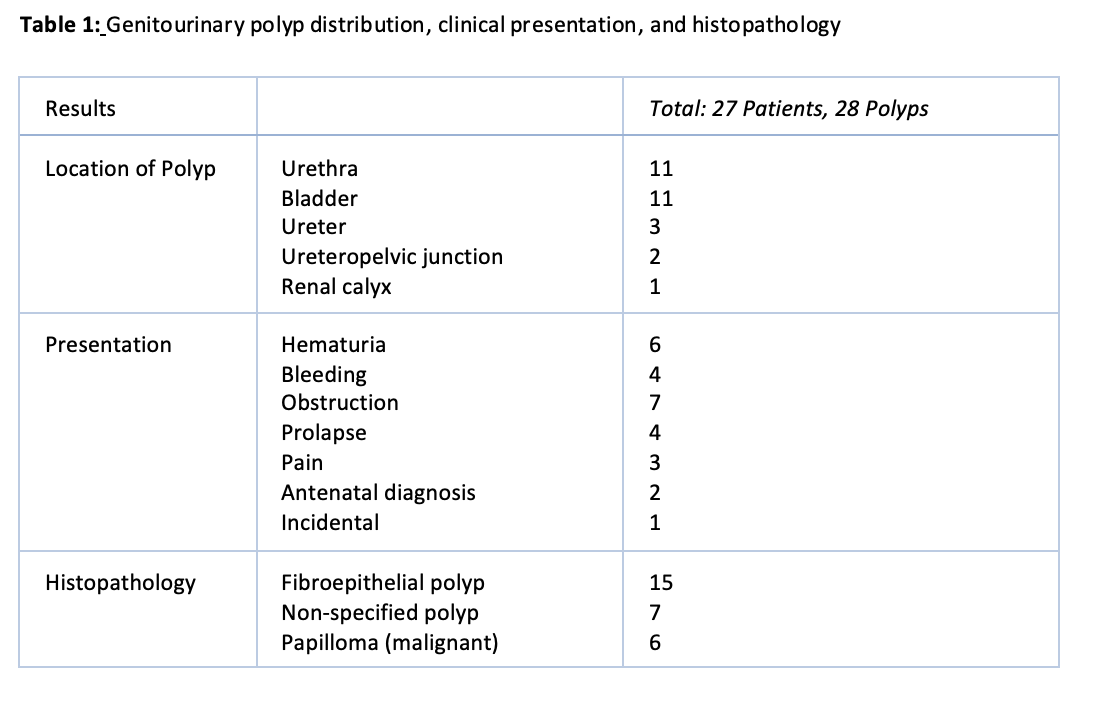
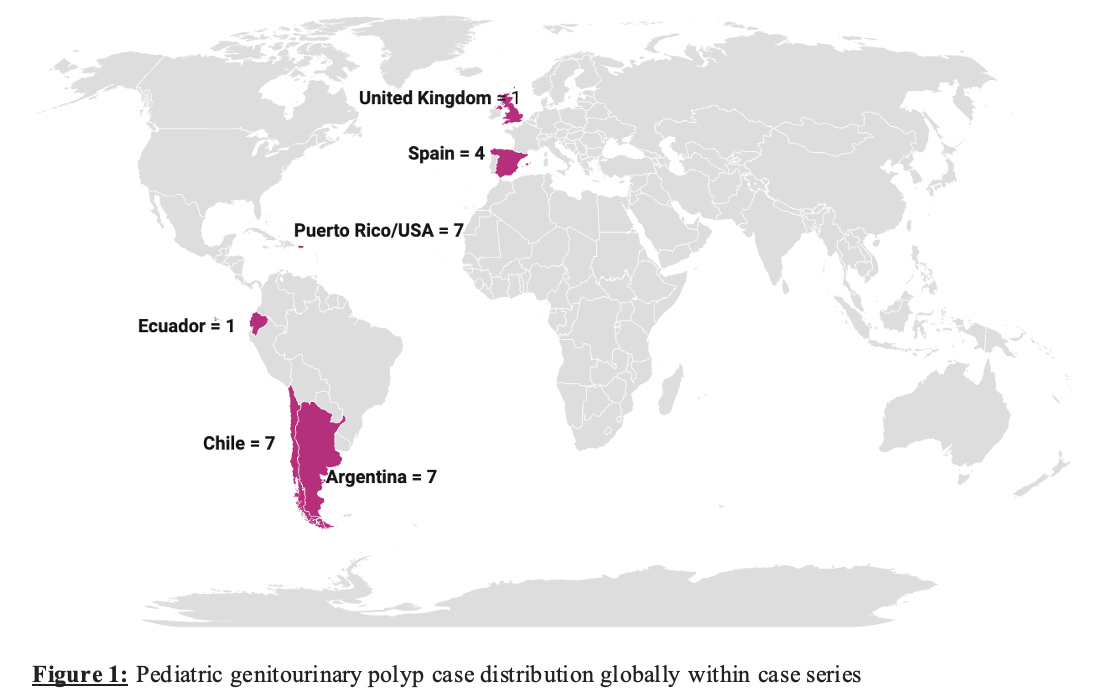
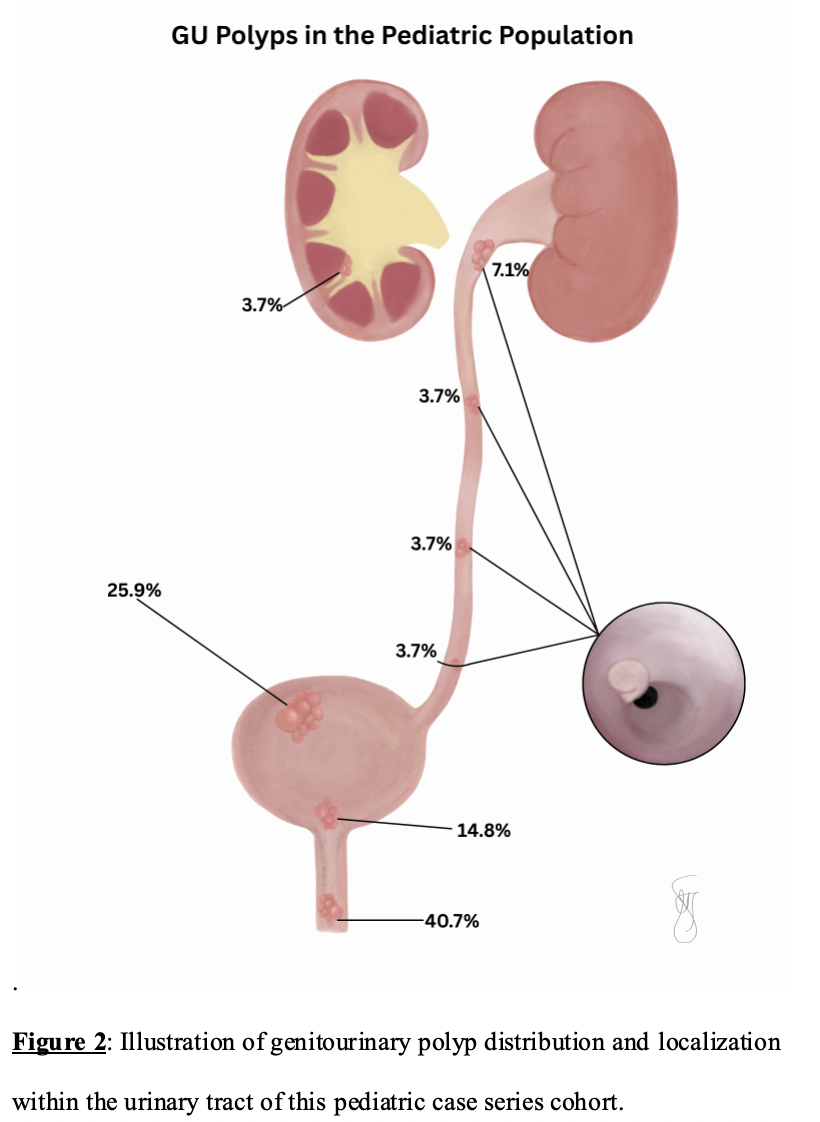
RESULTS: Between 2007 to 2025, 27 children with 28 GU polyps were identified from 13 centers across 6 countries (Figure 1). Nineteen (70.3%) were male. Mean age at surgery was 6.9 years (range 7 days-17 years). Most polyp locations included the urethra (40.7%) and bladder (40.7%) (Table 1). Main Presenting manifestations included hematuria or bleeding (37%) and obstruction/urinary retention (26%). Ultrasound was obtained in 23 children, with 26% showing no specific findings; voiding cystourethrogram was performed in 6 patients, all with polyp obstruction visualization. Initial management included endoscopic or transurethral resection/fulguration (n=20), open resection (n=5), and robotic reconstruction (n=2). Histopathology demonstrated fibro-epithelial polyps (48%), non-specified polyps (30%), and papilloma with malignant features in 6 cases (21%) (Table 1). Follow-up was available for 20 children (mean 2.9 years; range 1-10 years), and only 1 recurrence occurred after 1 year.
CONCLUSION: This global multicenter series demonstrates anatomic diversity, varied presentation, and the predominantly benign nature of rare conditions such as pediatric GU polyps. Endoscopic resection is the most common and typically definitive therapy, with low recurrence and favorable long-term outcomes. Resection and histopathology are mandatory, as 21% of lesions in our cohort exhibited malignant characteristics and 1 recurrence. Ongoing international collaboration is essential to improve diagnostic accuracy, refine management strategies, and establish evidence-based guidelines for follow-up in children with GU polyps.
Back to 2026 Display Posters


