Back to 2026 Display Posters
Challenges in the Management of Proximal Hypospadias for Early Career Pediatric Urologists
Tatjana Heisinger-Heidler, M.D., Ilina Rosoklija, MPH, Emilie K. Johnson, M.D.,MPH, Elizabeth B. Yerkes, M.D., James T. Rague, M.D..
Lurie Children's Hospital, Chicago, Chicago, IL, USA.
Background:Proximal hypospadias repair is technically complex, with numerous surgical techniques available and variable outcomes. Fellowship programs aim to prepare trainees for independent practice in the management of proximal hypospadias, but case exposure is often limited and inconsistent. Case volume early in practice may also be limited. The specific challenges faced by early-career pediatric urologists and how fellowship training and early career support can be improved remain unclear. Therefore, the aim of this study was to examine the fellowship experiences and challenges faced by early-career pediatric urologists in the management of patients with proximal hypospadias.
Methods: An anonymous, web-based survey was sent to fellowship-trained pediatric urologists within 1-5 years of completing a 2-year ACGME (Accreditation Council for Graduate Medical Education)-accredited fellowship at the time of the study to assess fellowship experiences, perceived preparedness for practice, and early-career challenges in managing proximal hypospadias. Respondent demographics were obtained. Survey items were analyzed descriptively with proportions (n/N (%)). Not all survey items were completed by each participant. Subgroup analyses comparing respondents with 1-2 years (“less experienced”) versus 3-5 years (“more experienced”) of practice were performed using chi-square and Fisher’s exact tests.
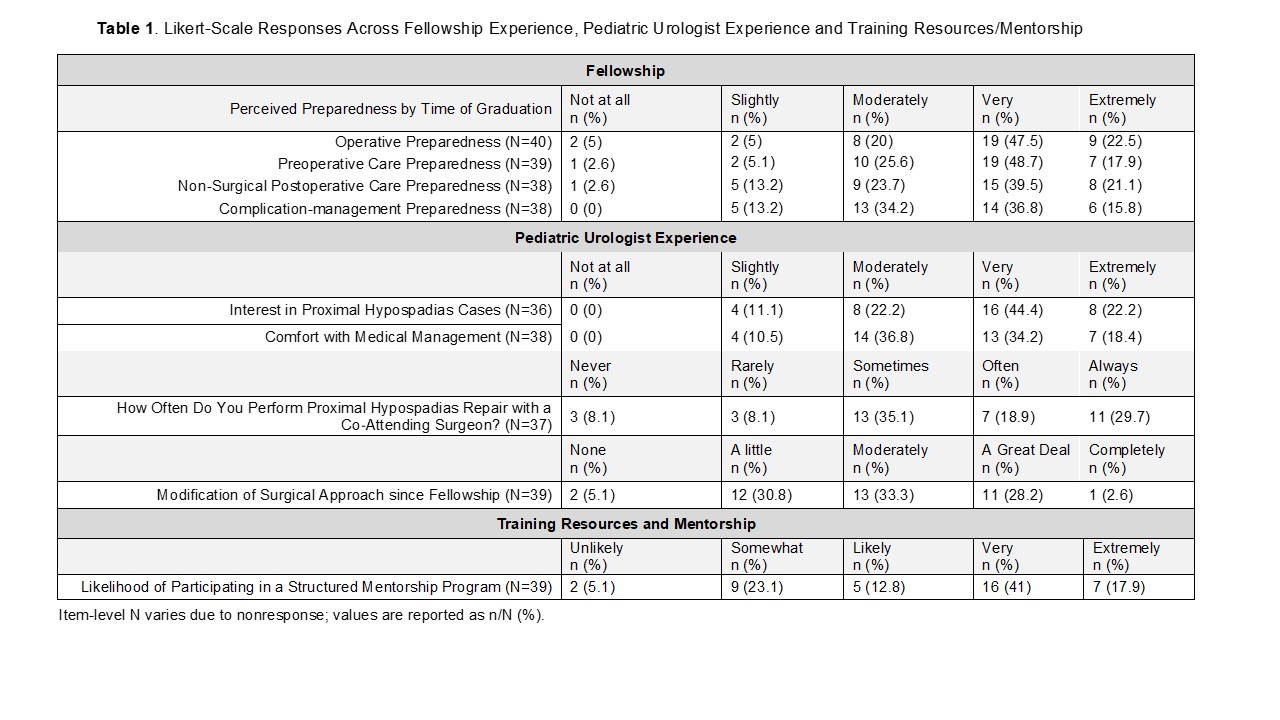
Results: Of 92 individuals contacted, 40 (43.5%) responded. Most were male (21/39; 53.8%), aged 30-39 years (33/39; 84.6), and practiced in academic settings (34/39;87.2%). Although most respondents felt very well prepared for preoperative, operative, and postoperative care after fellowship (Table 1), early-career challenges were identified, including difficulty with intraoperative decision-making (25/38;65.8%), low case volume (21/38;55.3%) and difficulties with postoperative complication management (16/38;42.1%). Since fellowship, 74.4% (29/39) performed fewer than 10 proximal hypospadias cases annually. While informal mentorship was common (31/39;79.5%), formal mentorship was rare (1/39; 2.6%). Respondents frequently used discussions with senior colleagues (34/39;87.2%), fellowship notes (29/39;74.4%) and surgical videos (26/39;66.7%) to prepare for complex cases. Respondents felt that observing senior colleagues (29/38;76.3%), hands-on courses (24/38;63.2%) and direct mentorship after fellowship (23/38;60.5%) could lead to improved operative confidence. Less experienced respondents reported lower annual case volumes (p=0.02) and most frequently identified infrequent case exposure as primary early-career challenge (p=0.004). More experienced respondents reported making more modifications to surgical technique since fellowship (p= <0.001).
Conclusion: While most respondents felt well prepared to perform proximal hypospadias repair upon fellowship completion, this preparedness did not always translate into confidence during early independent practice. Primary early career challenges included intraoperative decision-making and limited case exposure. Low case volumes and the desire for additional mentorship emerged as key components to improve confidence, highlighting the potential value of implementing structured mentorship programs and targeted educational strategies to better support early-career pediatric urologists managing complex, low-frequency proximal hypospadias cases.
Back to 2026 Display Posters


