Back to 2026 Display Posters
A SCOPING REVIEW OF THREE DECADES OF PEDIATRIC HYPOSPADIAS LITERATURE REPORTING: ARE WE CLOSE TO HAVING STANDARD DEFINITIONS?
Melise A. Keays, MD MSc1, James Rague, MD MS2, PANKAJ DANGLE, MD3, VICTORIA LAROCCA, PhD1, LUIS BRAGA, MD PhD4, NICOLAS FERNANDEZ, MD PhD5, CHRISTOPHER LONG, MD6, Erin McNamara, MD MPH1.
1Boston Children's Hospital, Boston, MA, USA, 2Ann and Robert H. Lurie Children's Hospital of Chicago, Chicago, IL, USA, 3Riley Hospital for Children, Indiana, IL, USA, 4McMaster Children's Hospital, Hamilton, ON, Canada, 5Seattle Children's Hospital, Seattle, WA, USA, 6Children's Hospital of Philadelphia, Philadelphia, PA, USA.
Background: Given the high variability in severity of hypospadias and lack of standardized reporting criteria, controversy exists regarding descriptive terminology used in clinical practice and published research. The objective of this study is to characterize trends and variability in preoperative phenotypic reporting in pediatric hypospadias literature and identify gaps that may inform the development of standardized diagnostic criteria.
Methods: This study used scoping review methodology to describe reporting criteria of preoperative pediatric hypospadias between 1990 and 2023. Articles were included if they had a pediatric population between 0-18 years with hypospadias, reported minimum of one diagnostic criterion or describe outcomes (i.e. meatus, curvature, glans, urethra, etc.), were available in English, and empirical in study design.
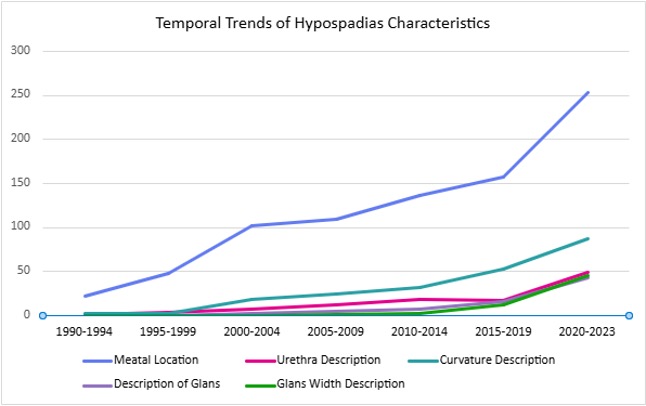
Results: 3,298 articles were screened, 1,306 articles were included for full-text review, and 830 met inclusion criteria and included for analysis. An increasing number of articles with diagnostic criterion were reported over time: 1990-2000 (n=86), 2001-2010 (n=222) and 2011-2020 (n=343) and 2021-2023 (n=179). More than 30 descriptions of meatal location were found with an average of 3.0, range 1-11/paper. Most reported meatal locations were distal (n=407), mid-shaft (n=214), proximal (n=296) and 33% added further characterization (e.g., glandular, coronal, penoscrotal, perineal, etc.). Twenty-six percent of studies reported penile curvature, with significant overlap in degrees of curvature to classify as mild, moderate or severe. Urethral plate was described in 13% of studies including descriptions of urethra as well as discrete measurements (width, length or both). Glans descriptors (i.e., width, size, shape) were present in 9% of studies with a mean glans width of 13.3mm(SD=5.07). The majority (63%) of studies reported only meatal location, 30% described meatus plus 1 other feature (glans/urethra or curvature) while 1.5% of studies provided meatal location, curvature, urethra, and glans descriptors. Trends in reporting over time are summarized in Fig 1.
Conclusion: This comprehensive review spanning three decades indicates that most hypospadias studies offer minimal clinical information beyond meatal location. There is an increasing trend toward comprehensive reporting including penile curvature, glans and urethral characteristics however, it remains limited to a small proportion of studies. Persistent overlap and inconsistency in classification categories, particularly for penile curvature, continue to limit comparability across studies. These findings underscore the need for practical and standardized reporting criteria to enhance comparative research and encourage widespread adoption.
Back to 2026 Display Posters


