Back to 2026 Display Posters
Opioid Stewardship in Pediatric Ureteral Reimplantation: Implementation of Multimodal Analgesia Protocol Leads To A Marked Reduction in Discharge Prescribing Without Worse Outcomes
Jin Kyu (Justin) Kim, MD, MS, Kristin Day, MN, NP, Zoe Gückien, MD, MBA, Rosalia Misseri, MD, Shelly King, MN, NP, Benjamin Whittam, MD, MS.
Riley Hospital for Children, Indianapolis, IN, USA.
BACKGROUND:Pediatric opioid stewardship has accelerated over the past decade, yet temporal trends in discharge opioid prescribing after ureteral reimplantation, a procedure associated with meaningful postoperative pain, remain poorly characterized. Our service began opioid stewardship and postoperative multimodal analgesia protocol starting in 2022, with sequential addition of non-opioid options including benzodiazepines and methocarbamol. Herein, we aimed to define prescribing trends following pediatric ureteral reimplantation for recurrent urinary tract infection (rUTI), identify when prescribing significantly declined, and determine whether reduced opioid use was associated with worse postoperative outcomes.
METHODS:We performed a single-center retrospective review of 130 consecutive pediatric patients who underwent ureteral reimplantation for the indication of rUTI between February 2018 and September 2024. The primary exposure was likelihood of postoperative opioid use. Yearly and quarterly prescribing rates were calculated. Inflection points were identified using segmented logistic regression on patient-level data, with confirmatory PELT, binary segmentation, and cumulative sum (CUSUM) changepoint analyses. Pre- and post-inflection cohorts were compared for recurrent UTI, any postoperative UTI, febrile UTI, complications, and length of stay (LOS) using Fisher exact and Wilcoxon tests. Trends were also evaluated by age group (<2, 2-6, 7-12, and ≥13 years).
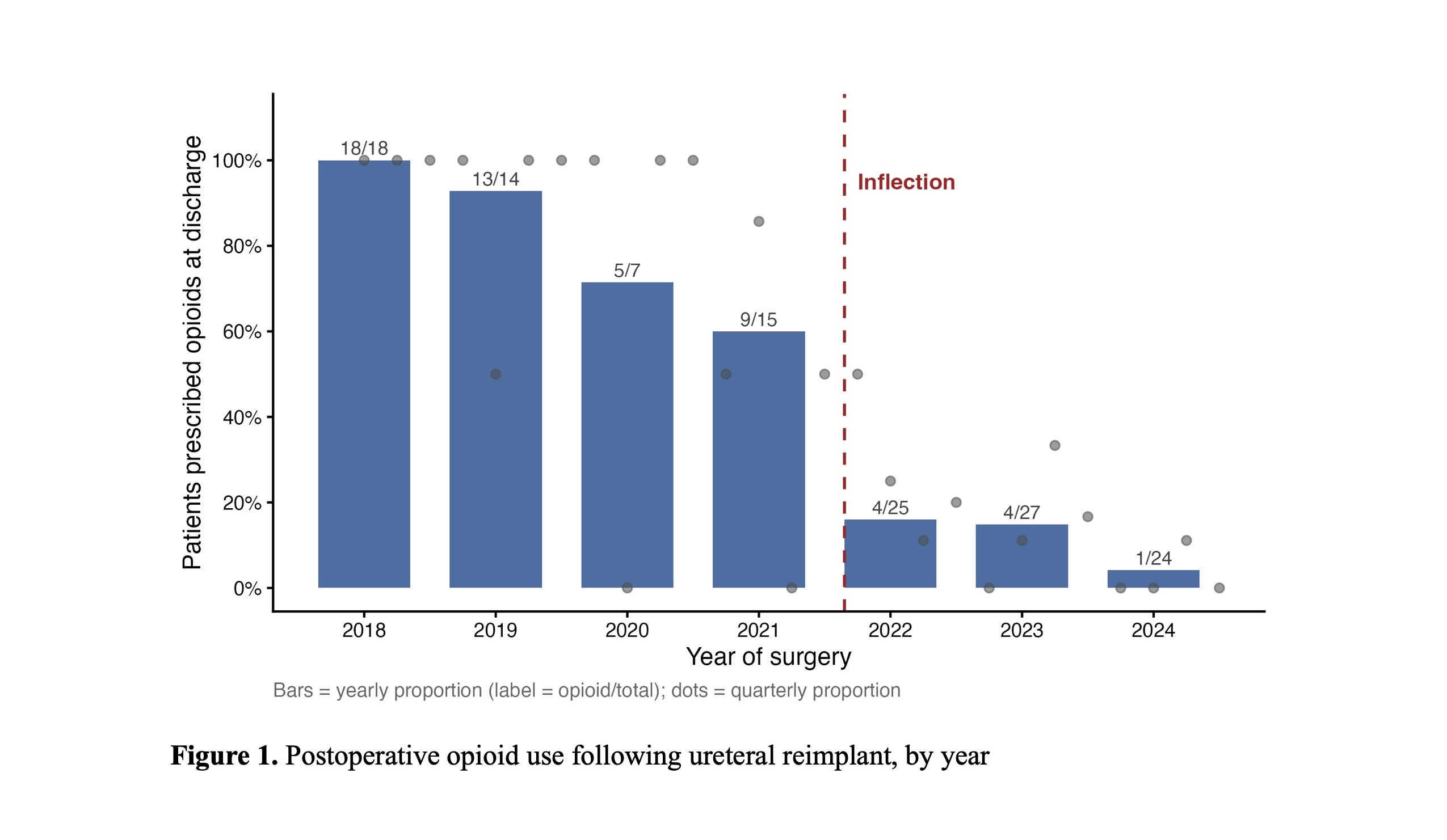
RESULTS:For children undergoing reimplantation for rUTI, the opioid use declined from 100% in 2018 to 4.2% in 2024 (18/18 vs 1/24). Annual use rates were 100% (2018), 92.9% (2019), 71.4% (2020), 60.0% (2021), 16.0% (2022), 14.8% (2023), and 4.2% (2024;
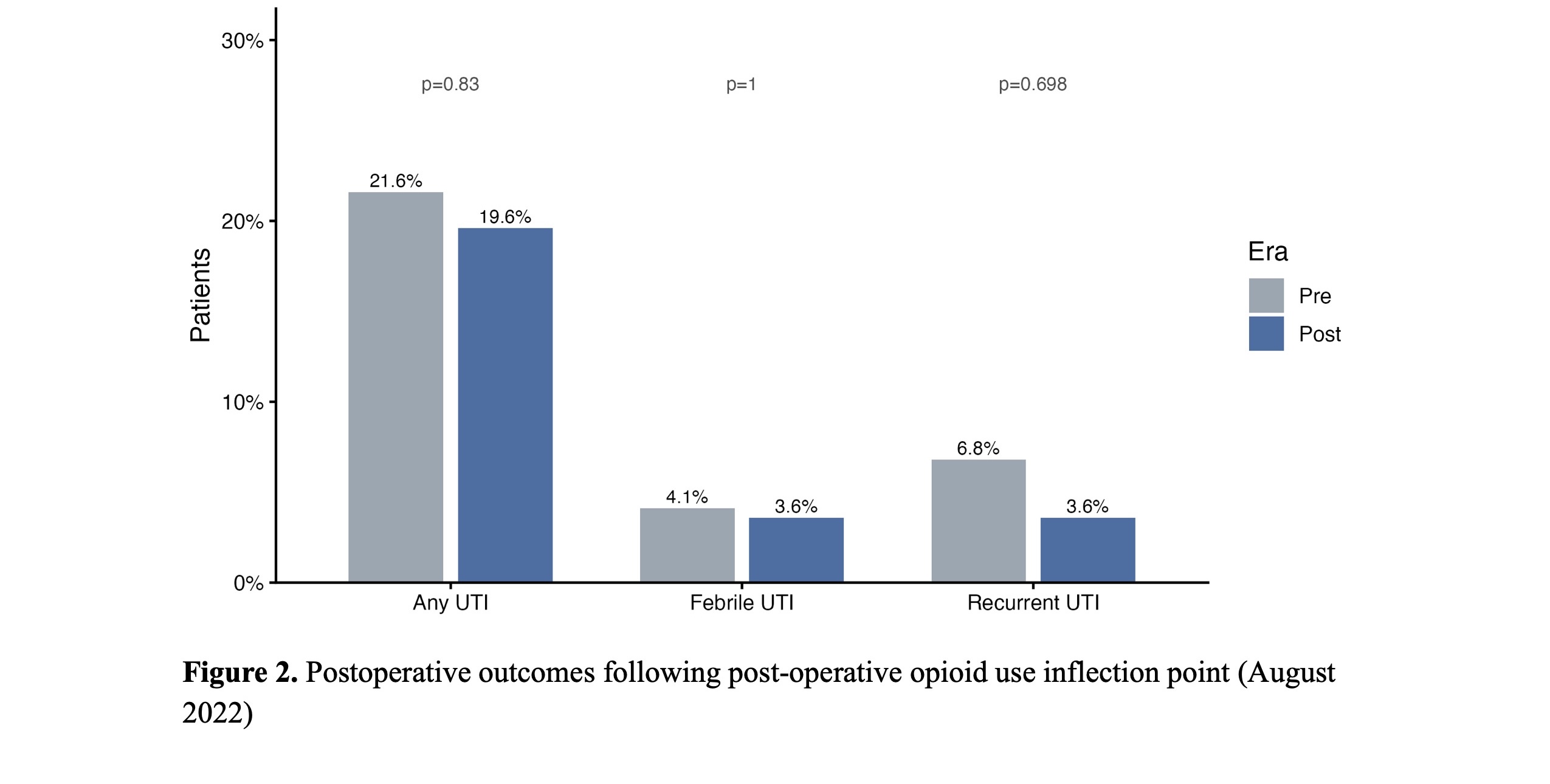
Figure 1). Segmented logistic regression identified an inflection point in August 2022 (95% CI March 2020-January 2025). Confirmatory changepoint analyses localized the transition to calendar year 2022.Using the segmented breakpoint, discharge opioid prescribing fell from 66.2% (49/74) pre-inflection to 8.9% (5/56) post-inflection (p<0.001). Reduced opioid prescribing was not associated with worse outcomes: recurrent UTI occurred in 6.8% versus 3.6% (p=0.70), any postoperative UTI in 21.6% versus 19.6% (p=0.83), febrile UTI in 4.1% versus 3.6% (p=1.0), and median LOS remained 1 day in both groups (p=0.34;
Figure 2). Significant reductions were observed across the <2, 2-6, and 7-12 year age groups (all p<0.005); the ≥13-year subgroup was underpowered. LOS remained stable over time (slope -0.027 days/year, p=0.27).
CONCLUSIONS:Postoperative opioid use after pediatric ureteral reimplantation declined sharply beginning in 2022, decreasing from near-universal prescribing to fewer than 10% of patients in recent years. This reduction was not associated with increased postoperative UTI, recurrent UTI, febrile UTI, or LOS. These findings support opioid-sparing pathways following pediatric ureteral reimplantation and provide a temporal benchmark for institutions implementing similar stewardship initiatives.
Back to 2026 Display Posters


