Back to 2026 Display Posters
Current Trends in Opioid Prescription at Discharge After Pediatric Urologic Procedures: Analysis of ACS NSQIP Pediatrics 2023 database
Sri Saran Manivasagam, MBBS, MS1, Jennifer A. Kane, MD2, Ross M. Decter, MD, FRCS (C)2.
1Virginia Commonwealth University, Richmond, VA, USA, 2Penn State Health Milton S Hershey Medical Center and College of Medicine, Hershey, PA, USA.
Background: Opioid prescribing at discharge after pediatric surgery contributes to opioid exposure, potential chronic opioid use, and increased community circulation of opioids. In pediatric urology, postoperative opioid use varies widely, and emerging evidence suggests that most procedures can be managed effectively with nonopioid analgesic pathways. Contemporary national data describing opioid prescribing patterns and associated factors in pediatric urology are limited. This study evaluates 2023 opioid prescription trends following pediatric urologic procedures using the ACS NSQIPPediatrics database.
MethodsA retrospective analysis of the ACS NSQIPPediatrics database (January-December 2023) was performed. Pediatric urologic procedures were identified using CPT codes and specialty designation. Patients were categorized by whether they received an opioid prescription at discharge. Demographic, clinical, and operative characteristics were compared using Mann-Whitney U and Chisquare tests. Multivariate logistic regression identified independent predictors of opioid prescribing.
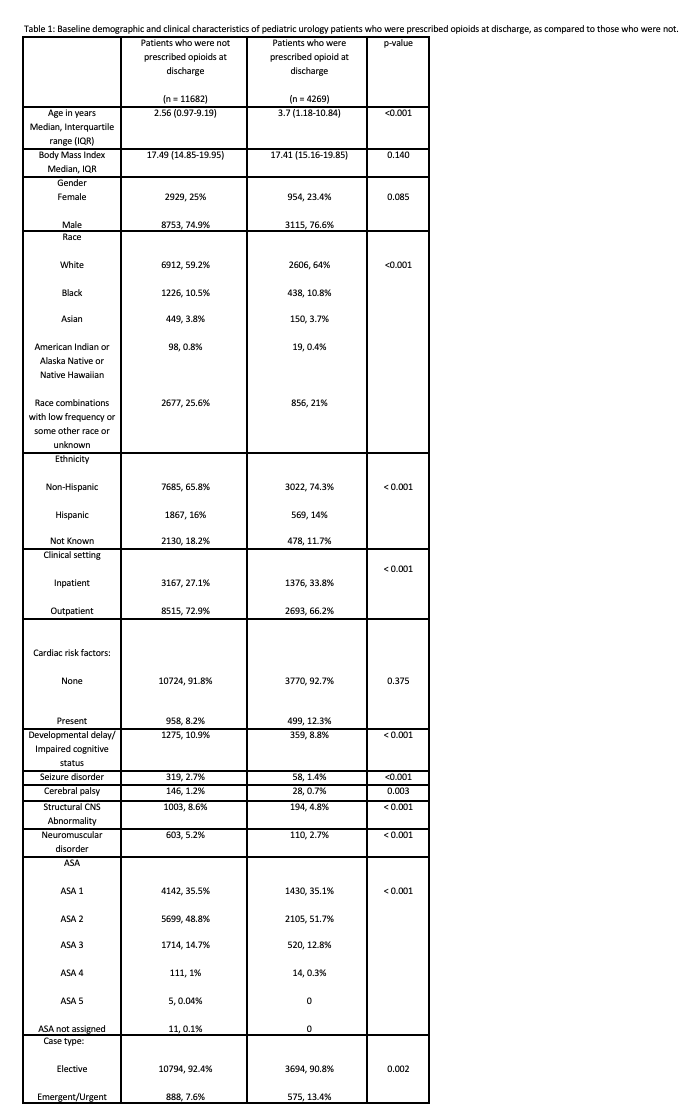
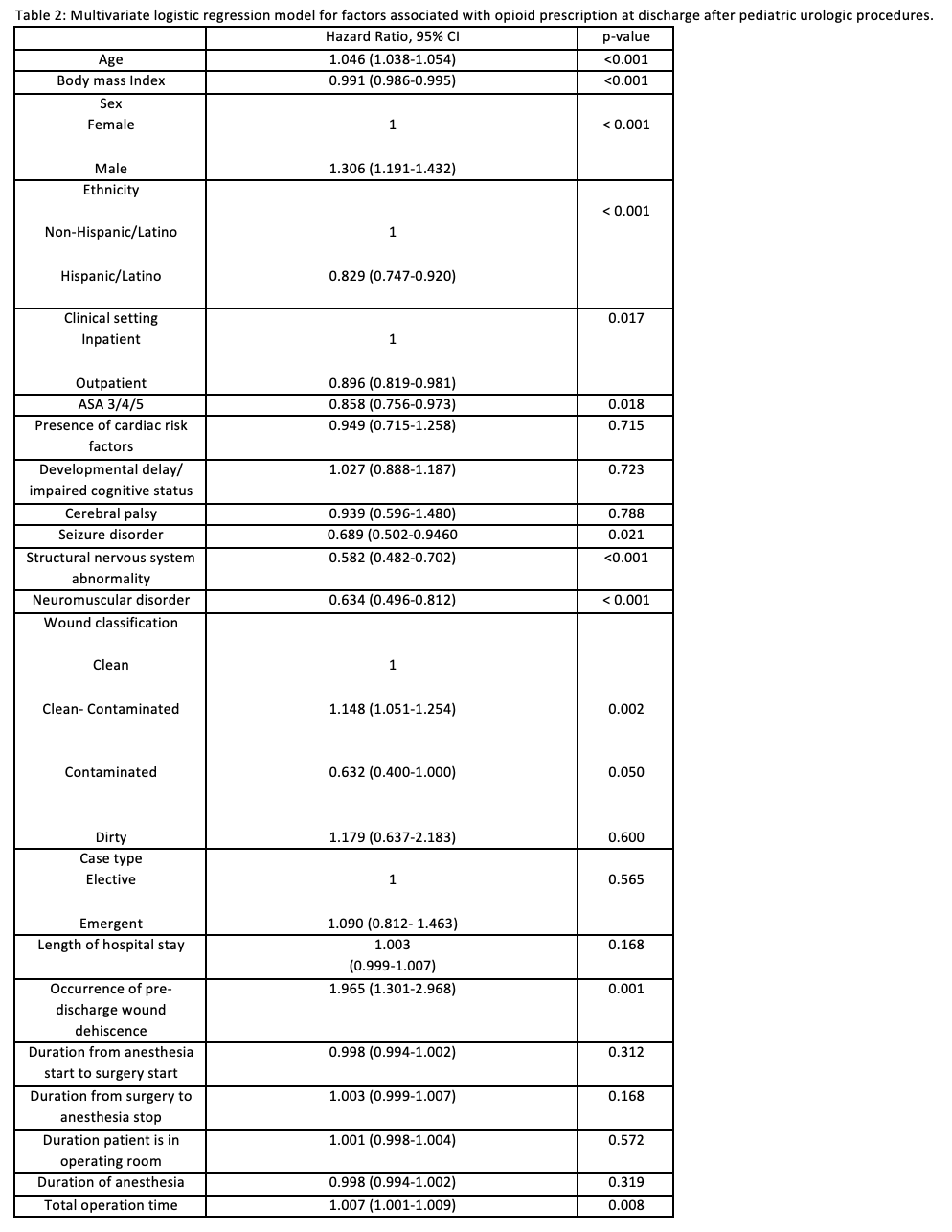
ResultsAmong 15,951 pediatric urologic cases, 4,069 (26.7%) received an opioid prescription at discharge. Oxycodone accounted for 72.2% of prescriptions. The highest prescribing rates occurred after ureteroneocystostomy (41.8%), staged hypospadias repair (33.1%), and testicular torsion repair (31.8%). Children prescribed opioids were older (3.7 years vs 2.56 years, p < 0.001), more often nonHispanic (74.3% vs 65.8%, p < 0.001), and more likely to undergo inpatient procedures (33.8% vs 27.1%, p < 0.001) (Table 1). On logistic regression, predictors of opioid prescribing included age (OR 1.046, p < 0.001), cleancontaminated wounds (OR 1.148, p = 0.002), wound dehiscence prior to discharge (OR 1.965, p = 0.001), and operative time (OR 1.007, p = 0.008). Hispanic ethnicity (OR 0.829, p < 0.001), outpatient surgery (OR 0.896, p = 0.017), BMI (OR 0.991, p < 0.001), seizure disorders (OR 0.689, p = 0.021), structural CNS abnormalities (OR 0.582, p < 0.001), and neuromuscular disorders (OR 0.634, p < 0.001) were associated with decreased odds (Table 2). Readmission and reoperation rates did not differ between patients receiving opioids at discharge and those who did not.
ConclusionsMore than one in four pediatric urologic patients continue to receive opioid prescriptions at discharge despite evidence supporting nonopioid analgesic pathways. These findings highlight persistent variability in prescribing practices and underscore the need for targeted quality improvement initiatives and prospective evaluation of opioid sparing strategies.
Back to 2026 Display Posters


