Back to 2026 Display Posters
Disease Severity Outperforms Area Level Socioeconomic Deprivation in Predicting Kidney Outcomes in Posterior Urethral Valves
Juliet Hardesty, MD1, Nikhil Batra, MD2, Joshua Roth, MD2, Benjamin Whittam, MD2, Konrad Szymanski, MD2, Kirstan Meldrum, MD2, Martin Kaefer, MD2, Richard Rink, MD2, Mark Cain, MD2, Rosalia Misseri, MD2, Jin Kyu Kim, MD2.
1Indiana University School of Medicine, Indianapolis, IN, USA, 2Riley Hospital for Children, Indianapolis, IN, USA.
BACKGROUND: Social determinants of health (SDOH) influence outcomes in pediatric chronic kidney disease (CKD), but their impact on kidney outcomes in posterior urethral valves (PUV), independent of intrinsic disease severity, remains unclear. We evaluated whether multiple area-level SDOH measures were associated with kidney outcomes in PUV after adjustment for the validated PURK (Posterior Urethral valve Risk of chronic Kidney disease) score.
METHODS: We performed a single-center retrospective cohort study of boys with PUV (born between 2007-2020) with ZIP code-linked SDOH measures including the Area Deprivation Index (ADI), Distressed Communities Index (DCI), and four American Community Survey-derived variables. Co-primary outcomes were (1) time to renal replacement therapy (RRT) (dialysis or transplant) and (2) CKD ≥3 ever, defined as CKD ≥3 documented at 1, 5, or 10 years post-diagnosis or progression to RRT. Time-to-RRT was analyzed using Cox proportional hazards models, while CKD ≥3 outcomes were analyzed using Firth-penalized logistic regression. ADI and DCI (per 10-unit increment) were pre-specified primary exposures, each adjusted for PURK score (calculated at time of initial presentation).Secondary analyses evaluated associations between SDOH and severity at presentation, care-process measures, longitudinal estimated glomerular filtration rate (eGFR) trajectory using linear mixed-effects models, and incremental prognostic value beyond PURK using leave-one-out cross-validated area under the curve (AUC).
RESULTS: Of 46 patients who were diagnosed with PUV at median of 7 days (IQR 3-18.5 days), 7 (15%) progressed to RRT, and 12 of 44 evaluable patients (27%) developed CKD ≥3 over a median follow-up of 10.3 years. After adjustment for PURK score, ADI was associated with longer time to RRT but this was not statistically significant (HR 0.57 per 10-unit increase, 95% CI 0.33-1.00, p=0.051). ADI was not associated with CKD ≥3 ever (OR 0.77, 95% CI 0.20-1.58, p=0.46). DCI was not associated with either outcome (RRT: HR 0.92, 95% CI 0.65-1.32, p=0.67; CKD ≥3: OR 0.81, 95% CI 0.33-1.46, p=0.48). No SDOH measure predicted CKD ≥3 at individual timepoints (1, 5, or 10 years; all Bonferroni-corrected p>0.05; Figure 1).SDOH measures were not associated with severity at presentation, care-process measures, or longitudinal eGFR trajectory (all adjusted p>0.05). PURK alone demonstrated excellent discrimination for CKD ≥3 progression (leave-one-out cross-validated AUC 0.987). Addition of ADI, DCI, or a principal component analysis-derived SDOH composite did not improve predictive performance (ΔAUC ≤0.006; DeLong p≥0.30).
CONCLUSIONS: In this single-center PUV cohort, intrinsic disease severity captured by the PURK score accounted for prognostic information for kidney outcomes. Area-level SDOH measures provided no incremental predictive value across kidney outcomes, severity at presentation, care-process measures, or longitudinal kidney function trajectory. In the absence of standardized PUV pathway, PURK remains a robust prognostic tool and children may follow their natural disease progression without consistent disease modifying effects.
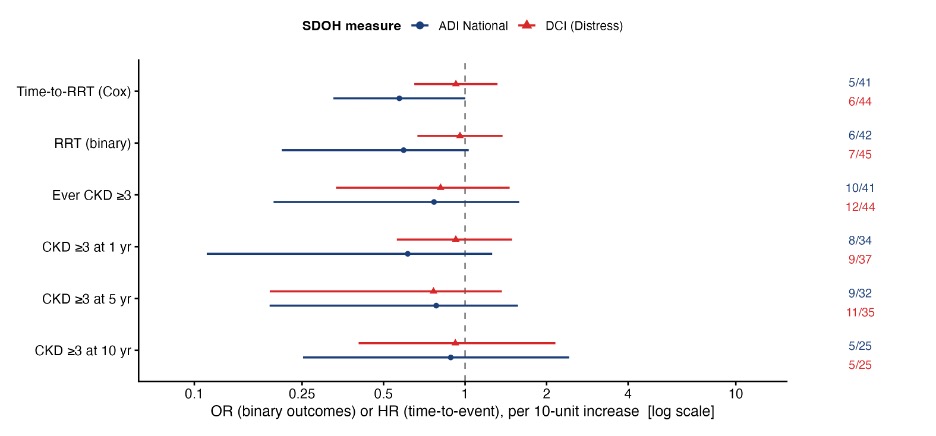 Figure 1.
 PURK score adjusted associations between area-level SDOH and kidney outcomes
Back to 2026 Display Posters


