Back to 2026 Display Posters
Intrarater Reliability of Immediate versus Delayed Interpretation of Pediatric Video Urodynamic Studies
Jennifer A. Kane, MD, Jacob B. Rethman, BS, Paul H. Smith, III, MD.
Penn State Health Milton S. Hershey Medical Center, Hershey, PA, USA.
BackgroundUrodynamic studies (UDS) are essential in pediatric urology, and interpretation accuracy directly impacts diagnosis and management. In many practices, UDS are performed in real time by advanced practice providers, while pediatric urologists provide a delayed interpretation using cystometrogram tracings, video images, and clinical data. However, the reliability of delayed interpretation compared with real-time interpretation is not well established. This study evaluated consistency between immediate and delayed interpretations of pediatric UDS tracings by an expert urodynamicist to quantify agreement and identify sources of variability.
MethodsAfter IRB approval, 336 pediatric UDS tracings (2018–2024) were reviewed. Patients aged 0–17 years with neurogenic or functional bladder diagnoses were included; repeat and inadequate studies were excluded. Forty-four patients were randomly selected for analysis. Immediate interpretations of UDS tracings were compared with delayed, blinded re-reads by a single urodynamicist. Video UDS parameters, including detrusor overactivity, end-fill detrusor pressure, safe bladder, capacity, compliance, stress urinary incontinence, and detrusor sphincter dyssynergia, were recorded. Agreement was assessed using Cohen's kappa and McNemar tests. Chi-square analysis evaluated associations between discordance and age, gender, and race. A paired t-test assessed intrarater reliability of continuous variables.
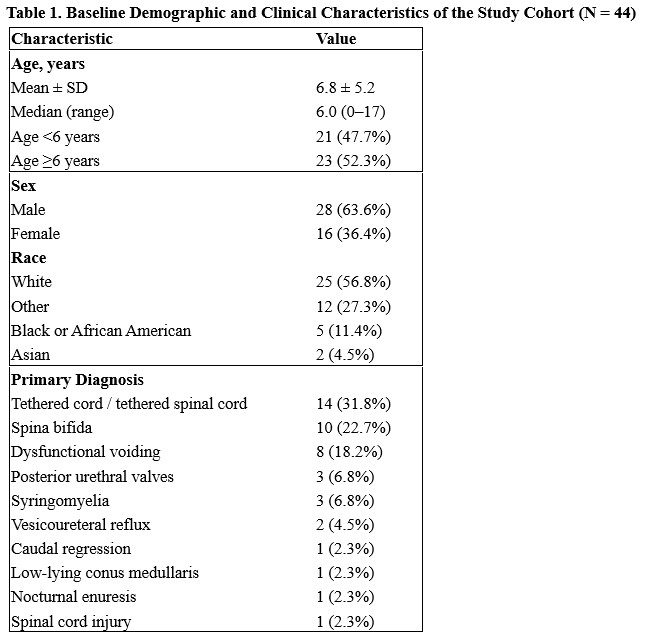
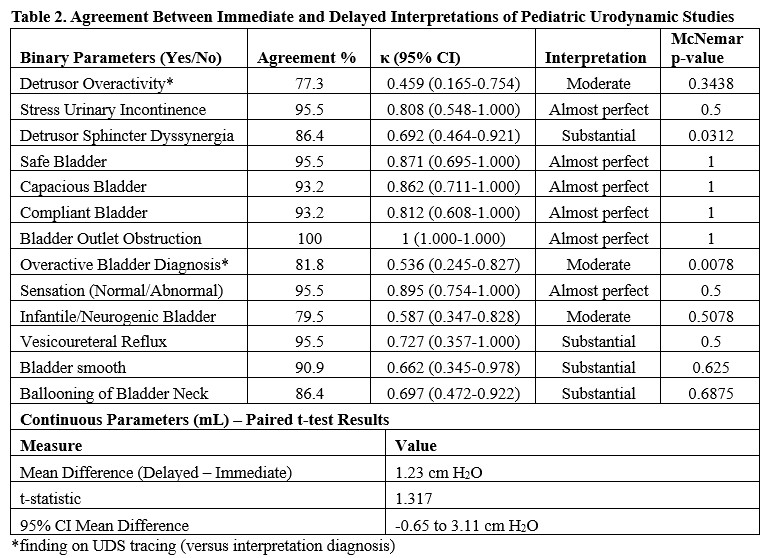
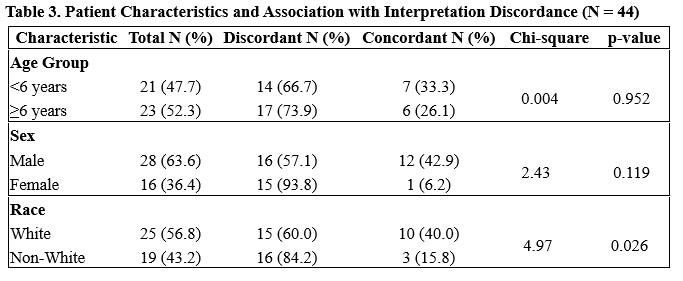
ResultsDemographic and clinical characteristics are summarized in Table 1. Agreement between immediate and delayed interpretations across 13 binary UDS parameters ranged from 81.8% to 100% (Table 2). Cohen's kappa values ranged from 0.46 to 1.00, with most parameters demonstrating substantial to almost perfect agreement. No parameter demonstrated significant directional discordance by McNemar testing (all p>0.05), indicating the absence of systematic interpretive bias. End-fill detrusor pressure did not differ significantly between immediate and delayed interpretations (mean difference 1.23 cm H₂O; p=0.195). Overall, 31 patients (70.5%) demonstrated at least one discordant interpretation. Discordance was not associated with age (<6 vs ≥6 years; Chi-square=0.004, p=0.952) or gender (Chi-square=2.43, p=0.119). Non-White patients demonstrated higher discordance rates than White patients (88.9% vs 57.7%; Chi-square=4.97, p=0.026), although this exploratory finding requires validation in larger cohorts (Table 3).
ConclusionsInterpretation of pediatric video urodynamic studies by an experienced urodynamicist demonstrated strong intrarater reliability, with substantial to almost perfect agreement across most parameters and no evidence of systematic interpretive bias over time. Continuous measurements, including end-fill detrusor pressure, remained stable between assessments. Although some variability was observed among more subjective parameters, overall concordance remained high. These findings support the reliability and reproducibility of delayed urologist interpretation workflows when video, cystometrogram tracing, and clinical data are available for review, and may inform future efforts to standardize interpretation criteria, improve consistency across providers, and optimize clinical decision-making.
Back to 2026 Display Posters


