Back to 2026 Display Posters
Defining Gaps in Urologic Care in Commercially Insured Patients with Spina Bifida Using Marketscan: A Retrospective Cohort Study
Kenneth A. Softness, MD1, Landon D. Hughes, PhD2, Robert F. LeCates, MA2, Caleb P. Nelson, MD MPH1, Laura F. Garabedian, MPH, PhD2.
1Boston Children's Hospital, Boston, MA, USA, 2Harvard Medical School, Boston, MA, USA.
BACKGROUND: Spina Bifida is the most common permanently disabling neurologic birth defect affecting individuals in the United States and causes varying degree of urologic and extra-urologic morbidity. The transition from pediatric to adult care is especially difficult in patients with spina bifida, as pediatric centers provide more comprehensive and supportive services to patients with physical and intellectual disability. Given the difficulty inherent in the period of transition, we hypothesize that patients with spina bifida are more likely to experience gaps in care beginning at transition, which is typically somewhere between 18-30. Guidelines suggest at least yearly surveillance for patients with spina bifida, and this may be more frequent for those with a more severe phenotype. Utilizing a national sample, we evaluated for gaps in care based on age to examine the trends in care engagement over the life course.
METHODS: We utilized Marketscan, a large national sample of commercial insurance claims between 2010 and 2025. We utilized ICD-9/10 codes to identify patients with spina bifida. We excluded patients over the age of 60. To identify outpatient urologic visits in the claims data, we combined specialty E/M outpatient CPT codes with provider flags for urologic specialties and/or urologic procedural codes in a hierarchical fashion. We then evaluated for gaps in care by each 12-month block of consecutive enrollment and separately then analyzed care gaps for individuals enrolled for a minimum of 12, 24 and 36 months separately, to evaluate the impact of continuous enrollment on care engagement. We performed sensitivity analysis separately evaluating care for patients with complex phenotype (CIC, VP shunt, bladder medication or botox instillation), against patients without.
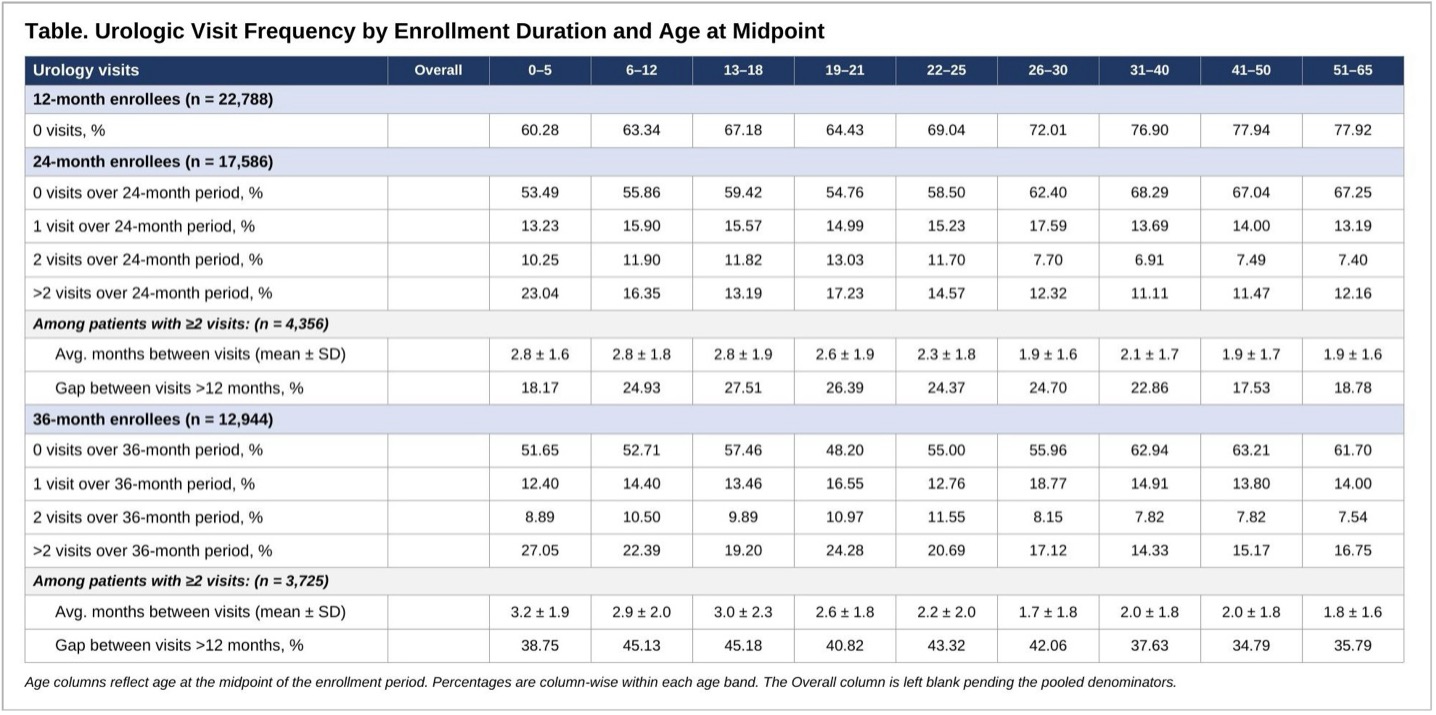
RESULTS: Table 1 describes the care gaps for patients with minimum of 12, 24 and 36 months of continuous commercial insurance enrollment. As expected, patients who are anchored into pediatric care have the highest care engagement, with the lowest proportion of patients experiencing gaps of 12-36 months. In the older age columns, disengagement with care increases with age, with the greatest proportion of gaps in care occurring in patients over the age of 25. Additionally, as age increases, the time between visits for those with >2 visits in the 24 and 36-month minimum enrollees decreases, suggesting a bimodal trend post-transition- sicker and more complex patients may engage regularly, while those without active complication are likely to space out care, while regular care for most patients pre-transition is the dominant trend.
CONCLUSIONS: Patients with spina bifida enrolled in commercial insurance plans experience progressive disengagement from care beginning in their 20’s, coinciding with transition away from pediatric care. Further work is aimed at evaluating the impact of gaps in care and progressive disengagement on health outcomes in patients with spina bifida, in whom regular urologic surveillance is considered key to long-term health and quality of life.
FUNDING SOURCE: Deborah P. Noonan Foundation Grant
Back to 2026 Display Posters


