Back to 2026 Display Posters
Non-Operative Management of Vesicocutaneous Fistulae in Pediatric Patients Treated with Negative Pressure Wound Therapy
Andrew Johnson, MD, Taeris Guzman, MS1, Raghav Shah, MS1, Olivia Green, MD1, Hannah Agard Bachtel, MD2, Eric Z. Massanyi, MD2.
1Northeast Ohio Medical University, Akron, OH, USA, 2Akron Children's Hospital, Akron, OH, USA.
BACKGROUND: Vesicocutaneous fistula (VCF) is a rare complication in children undergoing complex urologic reconstruction. Management can be challenging, as persistent urinary leakage and infection may lead to poor local tissue quality, limiting spontaneous closure. Traditional treatment typically involves prolonged urinary diversion and often surgical repair. Negative pressure wound therapy (NPWT) has emerged as an adjunctive therapy to promote tissue healing and facilitate spontaneous fistula closure in adults. However, limited data exist regarding the use of NPWT in the treatment of pediatric vesicocutaneous fistulae.
METHODS: We conducted a retrospective review of pediatric patients with vesicocutaneous fistula treated with NPWT at a single tertiary children’s hospital between 2021-2025. Demographic data, underlying diagnoses, surgical history, fistula characteristics, NPWT settings, duration of therapy, need for urinary diversion, and clinical outcomes were collected. Primary outcome was spontaneous fistula closure with NPWT. Secondary outcomes included time to closure, complications, and need for subsequent operative repair.
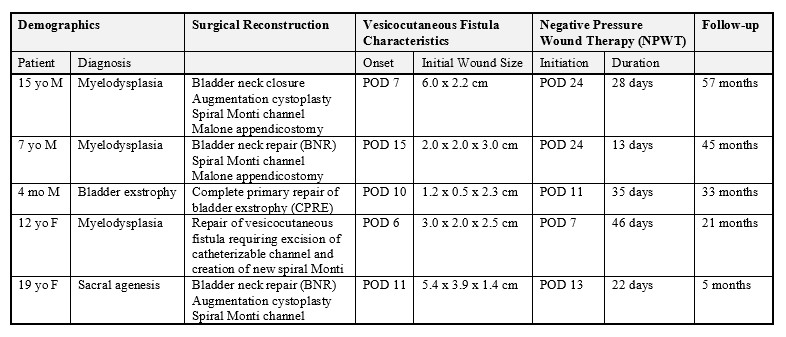
RESULTS: Five patients developed VCF after complex bladder reconstruction (
Table 1). All fistulae were identified in the early postoperative period (median postoperative day [POD] 10, range 6-15). Conservative urinary drainage failed in all cases, prompting NPWT initiation at 75 to 125 mmHg continuous suction on median POD 13, range 11-24). Median fistula size was 3.0 cm (range 2.3-6.0 cm) and assessed with dressing changes every 2-4 days. Median NPWT duration was 28 days (range 13-46). Spontaneous closure was achieved in all patients without additional urinary diversion or surgical intervention.
CONCLUSIONS: Negative pressure wound therapy (NPWT) is a safe and effective non-operative treatment option for the management of vesicocutaneous fistulae in pediatric patients with a history of complex urologic reconstruction. Larger studies are warranted to further define patient selection criteria and optimize treatment protocols.
Back to 2026 Display Posters


