Back to 2026 Display Posters
Intravesical Tobramycin Does Not Impact Kidney Function in Children with Complex Lower Urinary Tract Conditions Irrespective of the Presence and Grade of Vesicoureteral Reflux
Nikan Zerafatjou, MD, Mandy Rickard, MN, NP-Peds, Abby Varghese, RN(EC), NP-PHC, Ana Bernal, MD, Michael Chua, MD, MASc, DSc, DRCPSC, FRCSC, Armando Lorenzo, MD, MSc, FRCSC, FAAP, Joana Dos Santos, MD, MSc, FRCPC.
The Hospital for Sick Children (SickKids), University of Toronto, Toronto, ON, Canada.
BACKGROUND: Systemic aminoglycosides cause nephrotoxicity through megalin-mediated proximal tubular uptake. Intravesical administration results in minimal systemic absorption; however, in children with vesicoureteral reflux (VUR), medication instilled into the bladder could theoretically reach nephrons via pyelotubular backflow, providing an alternative pathway for nephrotoxicity. We evaluated whether intravesical tobramycin is associated with renal function decline, with a particular focus on children with high-grade VUR.
METHODS: Retrospective single-centre cohort of 96 children receiving intravesical tobramycin for recurrent symptomatic UTIs. A 0.48 mg/mL tobramycin solution was prepared for once-daily intravesical instillation; the standard volume was 60 mL (74%; range 5-80 mL). The median dwell time was 2 hours (89% ≥2 hours). The median treatment duration was 269 days (range 14-2,688 days). Estimated glomerular filtration rate (eGFR) was calculated using the bedside Schwartz formula before and after treatment. VUR status and highest grade were recorded. Paired eGFR comparisons were assessed using the Wilcoxon signed-rank test. Correlations between instillation parameters and eGFR change were assessed using Spearman coefficients.
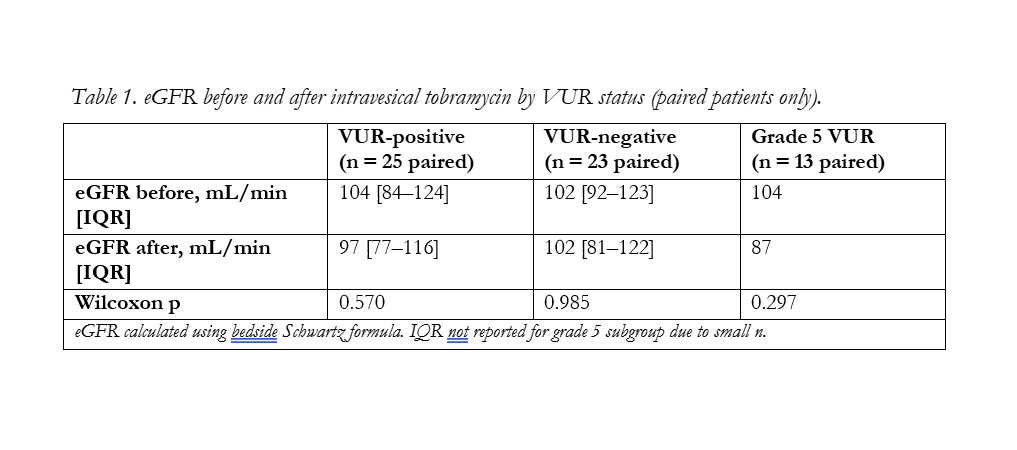
RESULTS: Of 96 patients, 49 (51%) had VUR, including 24 with grade 5 reflux. eGFR was preserved in both VUR-positive (104 to 97 mL/min/1.73 m², p = 0.570) and VUR-negative patients (102 to 102 mL/min/1.73 m², p = 0.985), with no significant overall change (p = 0.648). Baseline eGFR did not differ between groups (p = 0.865). Instillation volume showed a weak inverse correlation with eGFR change (Spearman r = −0.31, p = 0.037), whereas dwell time showed no meaningful correlation (r = −0.15). Among VUR-positive patients receiving the standard 60 mL volume, the median eGFR change was 0 mL/min/1.73 m² (n = 20), including those with grade 5 reflux (n = 13 with paired eGFR; Table 1). Findings were consistent across treatment durations up to 2,688 days.
CONCLUSIONS: Intravesical tobramycin was not associated with deterioration in kidney function over a median 9-month treatment course, irrespective of the presence and grade of VUR. The weak inverse correlation between instillation volume and eGFR change did not translate into clinically meaningful renal impairment, even at maximum volumes. These findings provide reassuring evidence supporting the continued use of intravesical tobramycin, even in patients with high-grade VUR.
Back to 2026 Display Posters


