Back to 2026 Display Posters
Patient-Prioritized Outcomes in Pediatric Kidney Stone Surgery: A Stakeholder-Engaged Mixed-Methods Study
Eugene C. Chen, BS1, Katherine Sheridan, MS1, Samantha Jacklin, BS1, Kathryn E. Flynn, PhD1, Gregory E. Tasian, MD, MSc, MSCE2, Jonathan S. Ellison, MD, FACS1.
1Medical College of Wisconsin, Milwaukee, WI, USA, 2Perelman School of Medicine at the University of Pennsylvania, Philadelphia, PA, USA.
BACKGROUND: Pediatric kidney stone disease is increasing and often requires surgical intervention. Procedural success is traditionally defined by stone clearance and complications, which may not reflect outcomes most meaningful to pediatric patients and caregivers. We aimed to identify and prioritize patient-centered outcomes for pediatric kidney stone surgery.
METHODS: We conducted a stakeholder-engaged mixed-methods study involving pediatric patients (ages 8-21 years) with prior surgical treatment for kidney or ureteral stones (ureteroscopy, shockwave lithotripsy, or percutaneous nephrolithotomy) and their caregivers, recruited through the Pediatric Kidney Stone (PKIDS) network, a consortium of 31 North American centers studying pediatric nephrolithiasis outcomes.In the qualitative phase, virtual focus groups were conducted using a semi-structured discussion guide. Transcripts were independently double-coded by two reviewers with qualitative research experience using a hybrid deductive-inductive analytic approach. Deductive codes were informed by outcomes previously identified in PKIDS work and inductive coding were used to identify novel themes. Thematic saturation was defined as no new themes emerging across successive groups with representation from both patients and caregivers.In the quantitative phase, identified themes were prioritized using structured pairwise comparison on Codigital™, an online collaborative prioritization tool that enables participants to compare outcomes through head-to-head voting. Ranked outcomes were then generated based on selection frequency. Participant characteristics were summarized descriptively.
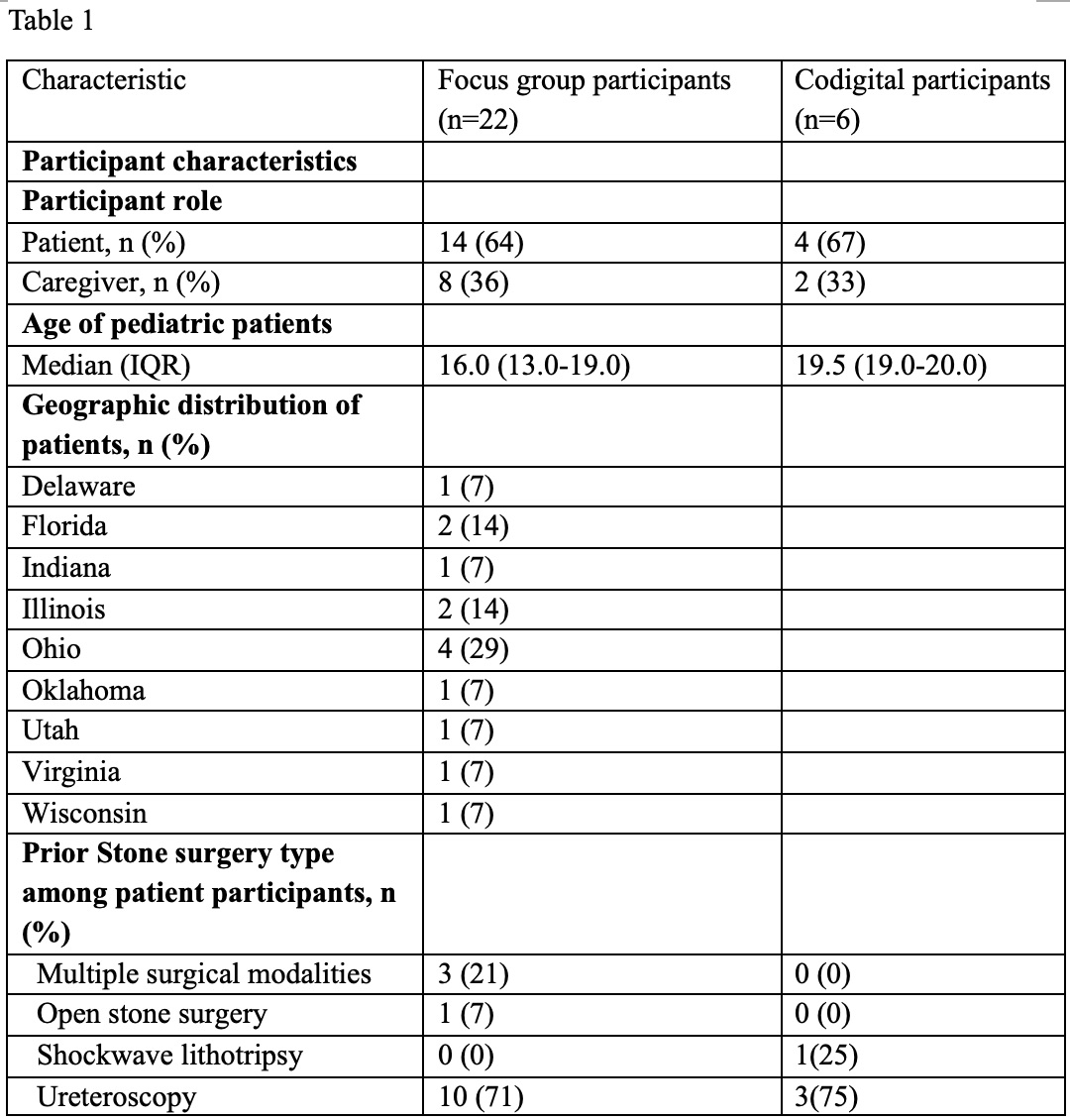
RESULTS: A total of 22 individuals participated in five focus groups, including 14 patients and 8 caregivers, with 3-8 participants per group (Table 1). Participants represented pediatric kidney stone patients from nine states and multiple health systems across the United States. Six participants completed the Codigital™ outcome prioritization exercise, including five participants who did not participate in a focus group. The median age of focus group participants was 19.0 years (IQR 13.0-19.0), compared with 20.0 years (IQR 19.5-20.0) among those completing the prioritization exercise. Among focus group patients, ten had undergone ureteroscopy, three had undergone multiple procedures, and one had undergone open surgery.Nineteen outcome themes were identified, with themes largely stabilized by the fifth session. Outcomes extended beyond traditional surgical metrics and those previously identified in PKIDS work to include additional psychosocial, functional, and procedural burden domains.Eight outcomes achieved >50% agreement, including stone clearance (59.5%), additional procedures (58.0%), kidney injury risk (56.8%), need for tubes or drains (56.1%), return to normal function (53.9%), urinary symptoms (52.7%), pain medication use (50.5%), and pain intensity (50.5%). No single outcome dominated prioritization, demonstrating that patient priorities are inherently multidimensional and not captured by traditional measures of surgical success.
 CONCLUSIONS:
 Pediatric patients and caregivers prioritize diverse outcomes that extend beyond traditional surgical metrics. These findings support integrating patient-prioritized outcomes into preoperative counseling and surgical decision-making and highlight the need to consider more patient centered outcomes when comparing effectiveness in pediatric kidney stone surgery.
Back to 2026 Display Posters


