Back to 2026 Display Posters
Survey of Practices on Experimental Reproductive tissue preservation in prepubescent Males (SPERM)
Austin Freedman, BS1, Chana Liberow, BA1, So Yeon Pak, MD2, Miriam Harel, MD2.
1Albert Einstein College of Medicine, NEW YORK, NY, USA, 2Montefiore Medical Center, NEW YORK, NY, USA.
BACKGROUND: Preserving fertility in males facing cancer treatments or medical conditions associated with infertility (e.g. Klinefelter, Fragile X) remains a significant clinical challenge, particularly for pre-pubescent boys who cannot undergo standard semen cryopreservation. Testicular tissue cryopreservation (TTC) has emerged as an experimental strategy that offers hope for future fertility preservation. The success of ovarian tissue cryopreservation in prepubertal girls provides strong support for advancements in reproductive technology, and many institutions are proactively banking testicular tissue for at-risk prepubescent boys. This study aims to investigate the current landscape of TTC in pediatric urology by examining availability, perceived barriers, and provider attitudes within both institutional and state-level sociopolitical contexts.
METHODS: Pediatric urologists across the United States were recruited via email through the Society of Pediatric Urology’s listserv. Participating urologists consented to complete a 16-question anonymous survey. The survey included questions on TTC availability, encouragement, departmental assistance, and perceived success and barriers. It also included questions on the respondents’ institution type, geographic location, and state’s political climate and response towards reproductive health. Only completed responses were recorded and analyzed using descriptive statistics.
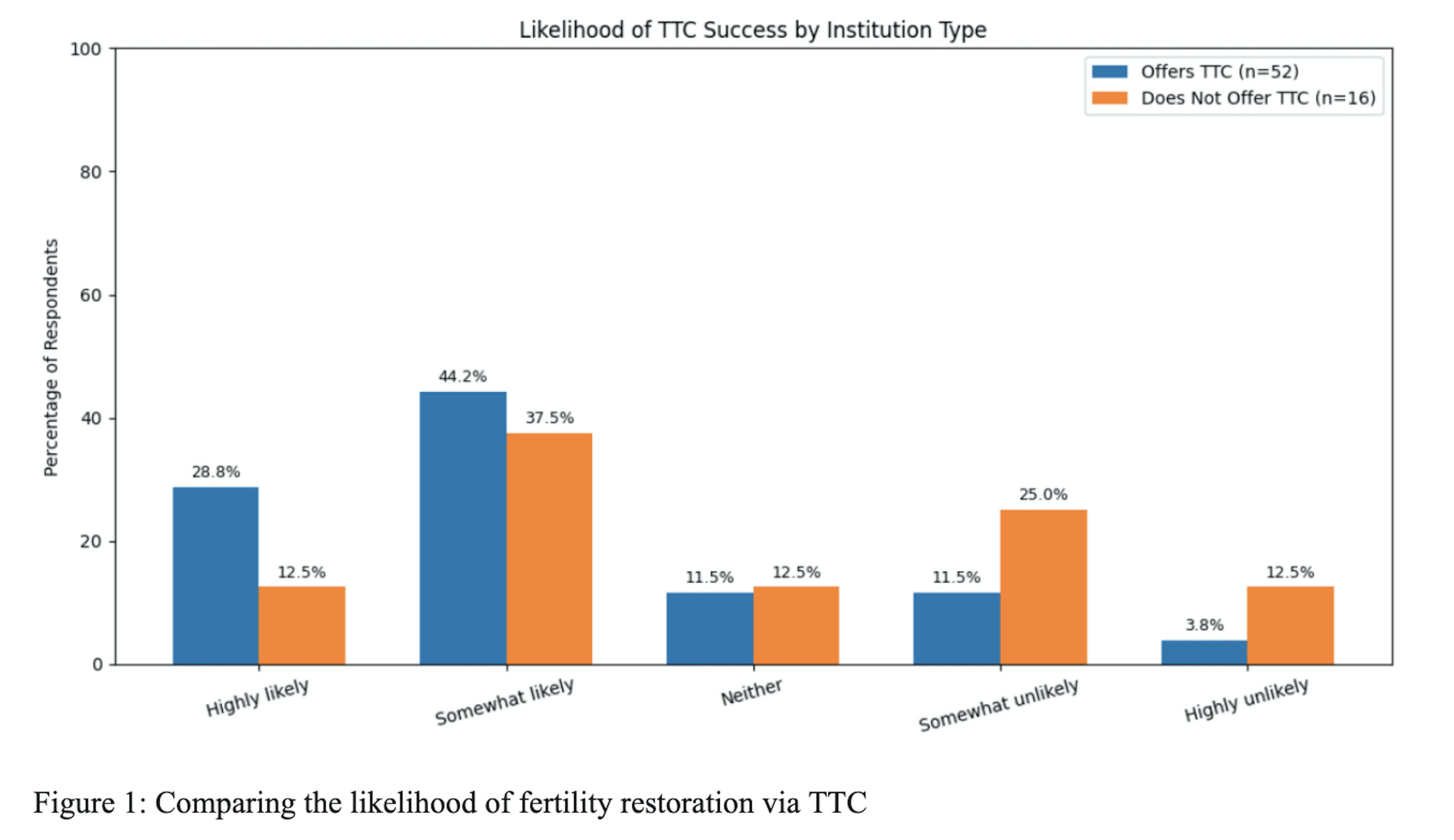
RESULTS: A total of 70 participants completed the survey, representing 30 states. Most respondents practiced in academic settings (64/70, 91.4%) and were affiliated with children's hospitals (65/70, 92.9%). Overall, 52 institutions (74.3%) offered TTC, whereas 16 (22.9%) did not. Of those that did not, 13/16 (81.3%) reported access to a tertiary referral center. Among institutions offering TTC, all offered to patients undergoing gonadotoxic cancer therapy (52/52, 100.0%). Fewer offered TTC for patients receiving gonadotoxic therapy for benign conditions (34/52, 65.4%) and hormone therapies or genital surgery (16/52, 30.8%). Compared with institutions offering TTC, institutions without TTC more commonly reported lack of institutional infrastructure (75.0% vs 17.3%), lack of laboratory capacity (68.8% vs 15.4%), and ethical or legal complexity (50.0% vs 15.4%) as barriers. In both groups, financial constraints were the most frequently reported barrier (45/70, 64.3%). State political climate varied with 35.7% described as conservative, 30.0% as progressive, and 27.1% as politically mixed; however, institutional support and perceived likelihood of TTC success were similar across all political climate categories. Overall, 17/70 (24.3%) respondents considered TTC highly likely to restore fertility in the future, while 29/70 (41.4%) found it somewhat likely to be successful. Of those institutions offering TTC, 15/52 (28.8%) of respondents anticipated a high likelihood of success within 10 years. In contrast, 2/16 (12.5%) respondents from institutions not offering TTC anticipated high likelihood of success, in either 15 or 25 years.
CONCLUSIONS: In this multistate sample, TTC availability and support were common among academic, children’s hospitals and were not influenced by geographic location or political affiliation. However, only a fraction (17/70 or 24.3%) of providers felt that TTC was highly likely to be successful in the future.
Back to 2026 Display Posters


