Back to 2026 Display Posters
CLINICAL UTILITY OF TUNICA VAGINALIS FLAPS FOR TESTICULAR TORSION
William N. Harris, MD, Juliana Arenas, MD, Alexandra M.C. Carolan, MD, Shane F. Batie, MD, Irina Stanasel, MD, Bruce J. Schlomer, MD, Micah A. Jacobs, MD, Craig A. Peters, MD.
University of Texas Southwestern Medical Center, Children's Health, Dallas, TX, USA.
BACKGROUND: Testicular torsion may produce compartment syndrome in the testis. Incising the tunica albuginea has been described to relieve pressure, followed by tunica vaginalis flap (TVF) for coverage. To evaluate TVF utility, we compared outcomes in patients undergoing detorsion with or without a TVF, stratified by preoperative pain duration, focusing on change in testicular volume.
METHODS: A database of 931 pubertal torsion patients from 2015-2023 was reviewed, with 92 boys included who had follow‑up ultrasound. TVF use was based on surgeon discretion. Average volume loss was compared between TVF and no‑TVF groups, stratified by pain duration (0-8h, 8-24h, >24h). Atrophy was recorded by exam at follow‑up. Volume change was compared using t‑tests; atrophy rates with Fisher’s exact test. Degrees of torsion were compared using Wilcoxon rank‑sum test. A sample of 20 patients was used to compare surgical time.
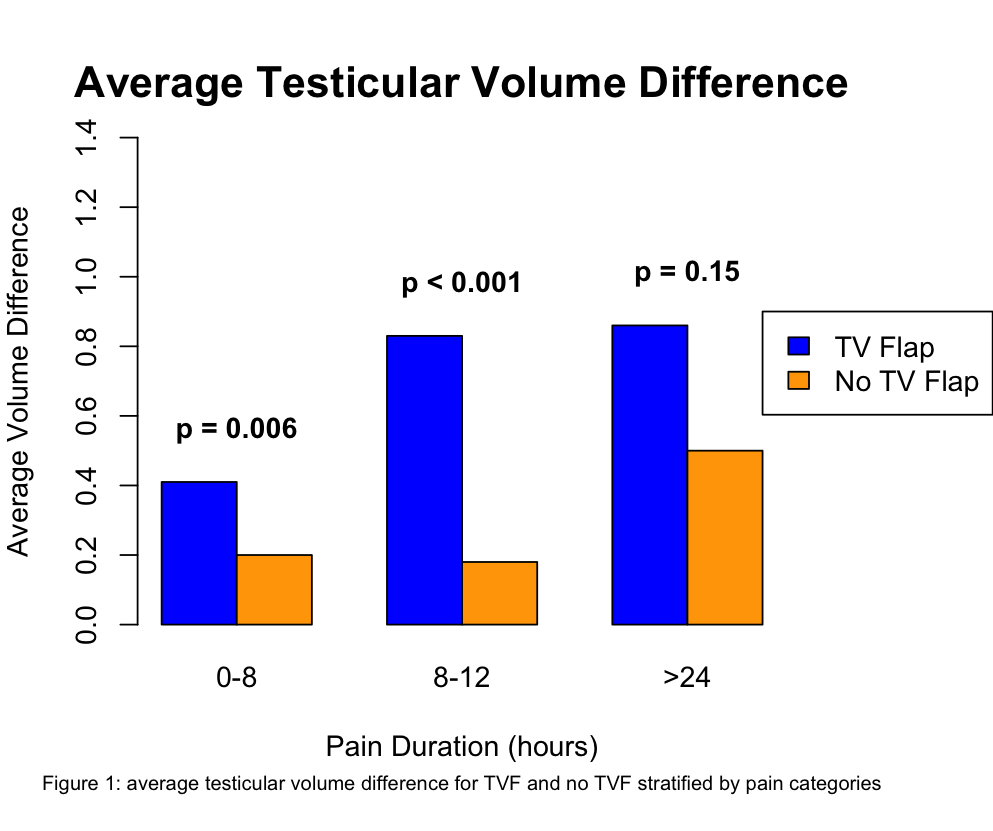
RESULTS: There were 92 patients included in the volume change analysis; 55 no TVF and 37 TVF. Median age was the same in both groups (TVF - 15 yrs (IQR 12.6-15.6); no TVF - 14.5 yrs (IQR 12.615.7)). The TVF group had statistically significant higher average testicular volume loss in 0-8h and 8-24h time categories (p=0.006, p<0.001, respectively, Fig. 1). For atrophy rates, there were 277 no TVF patients and 54 TVF patients. The TVF group had statistically significant higher rates of atrophy in the 4-8h, 8-12h, and 12-24h time categories (all p<0.01). The other time groups did not have a statistically significant difference in atrophy rates, by both exam and ultrasound. The mean degrees of torsion were not significantly different (TVF - 422° and no TV flap - 382° (p=0.2). Mean surgical time for the TVF group was 52 minutes and for the no TV flap group was 40 minutes (p<0.01 1-tailed t-test).
CONCLUSIONS:Although limited by its retrospective nature and non-standardization of performance of a TVF, our study shows, at best, no reduction in post-torsion atrophy rates or change in testicular volume with a TVF, and even higher rates in certain time categories. These data would suggest that TV flaps are of limited utility.
Back to 2026 Display Posters


