Back to 2026 Display Posters
What Actually Delays Care in Pediatric Testicular Torsion A 15 Year Analysis of Meteorological and Socioeconomic Factors
Leon Chertin, MD, Kohl Killeen, MD, Charis Royal, MD, Peyton J. Coady, BS, Jessica Makram, BS, Chrisla Key, DNP, PNP-PC, FNP, Amanda J. Travis, DNP, PNP-AC, FNP, Mary E. Killian, MD, EMBA, Dana W. Giel, MD, Mohamed Soltan, MD.
University of Tennessee Health Science Center, Memphis, TN, USA.
Objective. Testicular torsion is a time critical emergency in which treatment delay significantly increase the risk of orchiectomy. Since the link between delay and testicular loss is already established, the relevant clinical question is what causes the delay. Some literature suggests that meteorological factors influence testicular torsion incidence via cremasteric reflex, but the impact of weather on healthcare-seeking behavior and on clinical outcomes remains unclear. We hypothesized that different meteorological factors could delay presentation and increase risk of orchiectomy. We also aimed at evaluation of other factors might influence delay of care including socioeconomic and behavioral factors in a large pediatric cohort.
Methods. We performed a retrospective cohort study of pediatric patients with intraoperatively confirmed testicular torsion over a 15-year period at a tertiary referral center. Meteorological data (ambient temperature, seasonal distribution, and 24 hour fluctuations) were obtained by cross referencing patient residential zip codes with historical weather archives. The primary outcome was delayed treatment, defined as operative management initiated more than 24 hours from symptom onset. Patients were divided into two groups, delayed versus non-delayed, and compared across demographic, socioeconomic, presentation, and meteorological variables using Wilcoxon rank sum test for continuous variables and chi square or Fisher's exact test for categorical variables. Secondary outcomes included orchiectomy rates and association between the degree of torsion and testicular loss.
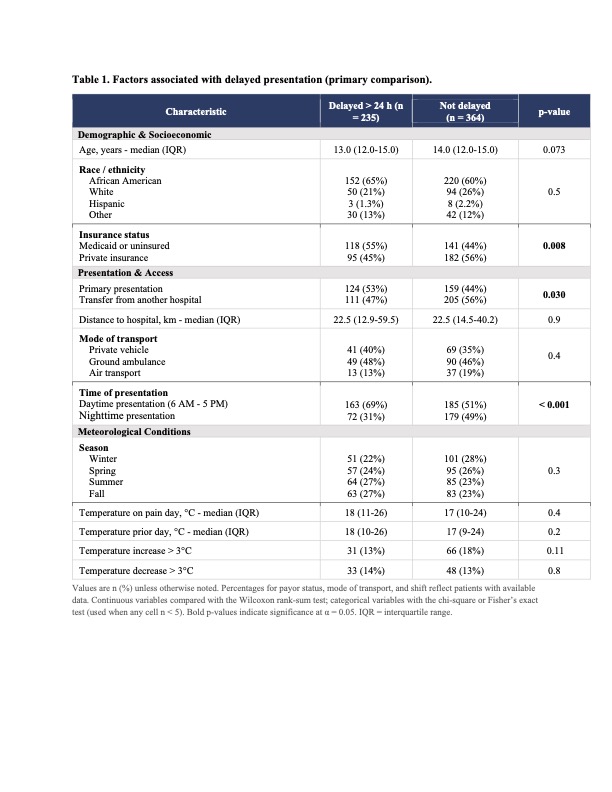
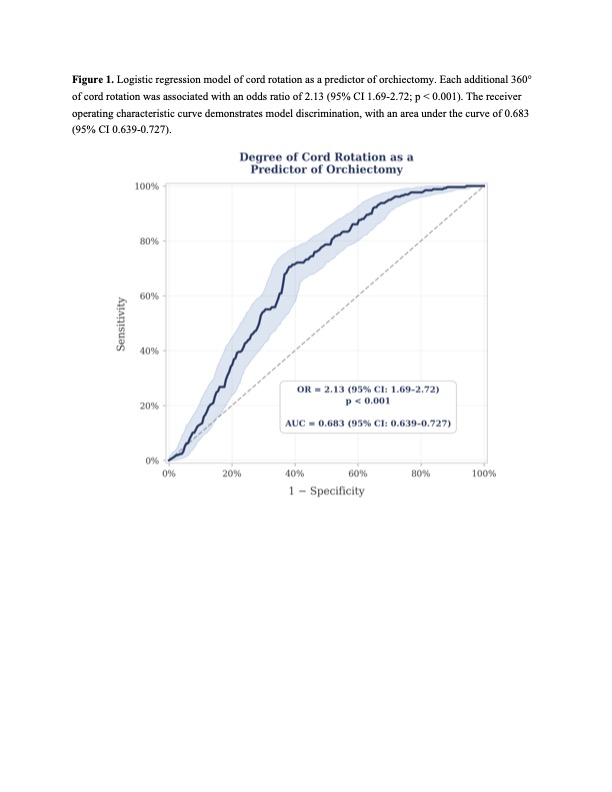
Results. 599 patients were included in the study, 235 (39%) in delayed group and 364 (61%) in non-delayed group. Three variables were associated with delay: Medicaid or uninsured status compared to private insurance (55% vs. 44%; p = 0.008), primary presentation vs transfer (53% vs. 44%; p = 0.030), and daytime arrival between 6 AM and 5 PM (69% vs. 51%; p < 0.001). No meteorological variable was associated with delay: season (p = 0.3), temperature on the day of pain (p = 0.4), and acute rise or drop of temperature by 3°C (p = 0.11, 0.8 respectively) (Table 1). Travel distance, mode of transport, age, and race were not associated with delay. As expected, delay strongly predicted orchiectomy: 87% of patients presenting beyond 24 hours underwent orchiectomy, compared with 15% of those presenting within 24 hours. Each additional 360° of cord rotation approximately doubled the odds of orchiectomy (OR 2.13; 95% CI 1.69-2.72; p < 0.001) (figure 1).
Conclusion. In this cohort, delayed presentation was driven by socioeconomic and behavioral factors: non private insurance status, primary presentation and daytime presentation. Presence of patients who waited to see their pediatrician for torsion might have played a role in the presentation route and time as most of these present directly to the hospital at daytime. Interventions aimed at reducing orchiectomy should focus on year-round symptom awareness, lowering the threshold for parents to present overnight.
Back to 2026 Display Posters


